The Watergate scandal remains one of the most consequential political scandals in American history. It exposed illegal political activities, the abuse of presidential power, and attempts to obstruct investigations at the highest levels of the United States government. The scandal ultimately forced President Richard Nixon to resign on August 9, 1974, making him the first and, to date, only American president to leave office through resignation.
What began with a seemingly ordinary burglary at the Democratic National Committee headquarters in Washington, D.C., developed into a national political crisis that threatened the foundations of American democracy. Investigations by journalists, law enforcement agencies, congressional committees, and the courts gradually uncovered evidence connecting members of Nixon’s administration to a broader effort to conceal the truth.
The Watergate scandal did not emerge overnight. Its roots lay in the political tensions, secret operations, and growing distrust that characterized American politics during Nixon’s presidency. Understanding how the scandal unfolded reveals how a criminal investigation became a constitutional crisis and why Nixon eventually concluded that he could no longer remain in office.
The Political Background Before Watergate
Richard Nixon became president of the United States in January 1969 after defeating Democratic candidate Hubert Humphrey in the 1968 presidential election.
His presidency unfolded during a turbulent period in American history. The country was deeply divided over the Vietnam War, civil rights, protests, and the direction of American foreign and domestic policy.
Nixon presented himself as a defender of law and order, promising to restore stability amid widespread political and social unrest. However, his administration became increasingly concerned about political opposition, government leaks, and the possibility of losing power.
Nixon and some of his closest advisers developed an increasingly aggressive approach to political intelligence and security. Their activities included efforts to obtain information about political opponents and prevent damaging information from reaching the public.
One important development was the creation of a special investigative unit within the White House, commonly known as the Plumbers. Established in 1971, the unit was intended to stop leaks of classified information.
Some of its members later became involved in activities that contributed to the Watergate scandal.
The political environment surrounding the Nixon administration provided the background for the events that would eventually threaten his presidency.
The Watergate Break-In of June 1972
The scandal takes its name from the Watergate complex in Washington, D.C., where the Democratic National Committee maintained its headquarters.
On June 17, 1972, five men were arrested inside the Democratic Party’s offices after breaking into the building.
The men were identified as Bernard Barker, Virgilio González, Eugenio Martínez, James McCord, and Frank Sturgis. They had entered the offices to install surveillance equipment and gather information.
Investigators discovered that the burglars had electronic surveillance equipment, cameras, and other materials associated with an intelligence-gathering operation.
James McCord was particularly significant because he had worked in security for the Committee for the Re-Election of the President, Nixon’s campaign organization for the 1972 election. He had also previously worked for the Central Intelligence Agency.
The discovery of McCord’s political connections raised questions about whether the burglary was an isolated criminal operation or part of a broader attempt to spy on the Democratic Party.
Initially, the incident attracted limited national attention. Nixon’s administration publicly distanced itself from the break-in, and the president went on to win re-election by a landslide in November 1972.
However, the arrests had set in motion an investigation that would eventually expose a far-reaching political scandal.
Two reporters at The Washington Post, Bob Woodward and Carl Bernstein, played an important role in uncovering the political connections surrounding the burglary.
Working with editors and relying on court records, interviews, and confidential sources, the journalists investigated the backgrounds of the arrested men and their links to Nixon’s re-election campaign.
Their reporting gradually revealed connections between the burglars and individuals associated with the president’s political operation.
One of their most important sources was an anonymous informant known publicly as Deep Throat. The source provided guidance that helped the reporters pursue important leads.
Deep Throat was eventually identified as Mark Felt, a senior FBI official, in 2005.
Woodward and Bernstein’s reporting raised questions about the source of money used by the burglars, the political intelligence operation, and attempts to prevent investigators from discovering the full extent of the activities.
Their work was important, but the Watergate scandal was not uncovered by journalists alone. The FBI, federal prosecutors, the courts, and congressional investigators also played essential roles in establishing the facts.
As evidence accumulated, the scandal increasingly threatened senior officials in the Nixon administration.
The Money Trail and the Cover-Up
One of the most important developments in the Watergate investigation was the discovery of financial connections between the burglars and Nixon’s re-election organization.
Investigators traced money associated with the burglary to funds connected to the president’s campaign.
This evidence helped undermine claims that the break-in had no meaningful connection to Nixon’s political operation.
The investigation also revealed efforts to conceal information and limit the damage caused by the arrests.
Several individuals connected to the administration became involved in discussions about how to contain the scandal. These efforts included attempts to influence the investigation and prevent damaging information from reaching the public.
The president was not arrested for the Watergate burglary, and the scandal was not simply a matter of proving that he had personally ordered the break-in. The critical issue increasingly became whether he had participated in or attempted to obstruct the investigation into the crime.
Evidence later established that Nixon had taken part in discussions about using the CIA to restrict the FBI’s investigation. He also became implicated in the broader effort to conceal the administration’s connections to Watergate.
The distinction between the original crime and the cover-up was crucial. Even as the burglars and their associates faced prosecution, the investigation continued to move closer to the White House.
The Senate Watergate Hearings of 1973
In February 1973, the United States Senate voted to establish a special committee to investigate the Watergate affair.
The Senate Select Committee on Presidential Campaign Activities, chaired by Senator Sam Ervin of North Carolina, began televised public hearings in May 1973.
Millions of Americans watched as witnesses testified about the burglary, campaign activities, and the efforts to conceal the scandal.
The hearings brought the investigation into American homes and made Watergate a major national issue.
One of the most consequential witnesses was John Dean, who had served as White House counsel.
Dean testified that the administration had engaged in efforts to cover up its involvement in Watergate. He also described conversations suggesting that Nixon had participated in discussions about the cover-up.
The White House disputed important parts of Dean’s account, creating a serious conflict over what had occurred inside the administration.
The investigation took another dramatic turn in July 1973 when Alexander Butterfield, a former presidential aide, revealed that Nixon had a secret recording system installed in the White House.
The system recorded conversations in certain presidential offices, including the Oval Office.
The existence of the recordings meant that investigators might be able to verify what Nixon and his advisers had actually said during important conversations.
The recordings soon became the central battleground in the struggle between the president and those investigating the scandal.
The Saturday Night Massacre
As investigators sought access to the presidential recordings, Nixon resisted efforts to obtain them.
The dispute intensified in October 1973, when Special Prosecutor Archibald Cox insisted on obtaining recordings relevant to the investigation.
Nixon proposed a compromise involving Senator John Stennis of Mississippi, who would review the recordings and provide summaries. Cox rejected the arrangement.
On October 20, 1973, Nixon ordered Attorney General Elliot Richardson to dismiss Cox. Richardson refused and resigned rather than carry out the order.
Deputy Attorney General William Ruckelshaus also refused and was dismissed after declining to comply.
Solicitor General Robert Bork, then acting attorney general, eventually carried out Nixon’s order and dismissed Cox.
The events became known as the Saturday Night Massacre.
The dismissals triggered widespread public outrage and intensified calls for Nixon’s impeachment. Critics argued that the president was attempting to interfere with an investigation that threatened his administration.
The crisis also strengthened the resolve of congressional investigators.
Rather than ending the investigation, the dismissal of Cox made the scandal even more damaging to Nixon’s presidency.
The Presidential Tapes and the Smoking Gun
The existence of the recordings created a direct confrontation between Nixon and the courts.
In April 1974, Nixon released edited transcripts of several conversations, hoping to demonstrate that he had not participated in criminal wrongdoing.
However, the transcripts contained profanity and revealed conversations that further damaged public confidence in the president.
Investigators continued to demand the original recordings.
The dispute eventually reached the United States Supreme Court in United States v. Nixon.
On July 24, 1974, the Supreme Court ruled unanimously that Nixon had to comply with a subpoena requiring him to produce the recordings for use in the criminal proceedings.
The Court rejected Nixon’s claim that a broad assertion of executive privilege allowed him to withhold the evidence.
The ruling was a decisive moment in the scandal. It established that the president was not above the law and that executive privilege could not be used to prevent the disclosure of evidence needed for a criminal investigation under the circumstances presented.
Among the recordings was a conversation from June 23, 1972, only days after the Watergate break-in.
In that conversation, Nixon discussed having the CIA tell the FBI to limit its investigation into the burglary by invoking national security concerns.
The recording provided direct evidence that Nixon had participated in discussions about interfering with the investigation.
It became widely known as the smoking gun tape.
Its release in August 1974 destroyed much of the remaining political support Nixon had among Republicans in Congress.
The recording demonstrated that the president had been involved in the cover-up much earlier than he had publicly acknowledged.
The House Moves Toward Impeachment
As evidence against Nixon accumulated, the House of Representatives began formal impeachment proceedings.
The House Judiciary Committee examined whether Nixon had committed impeachable offenses.
On July 27, 1974, the committee approved an article of impeachment charging Nixon with obstruction of justice in connection with the Watergate investigation.
The committee subsequently approved two additional articles.
One accused Nixon of abusing presidential power by using federal agencies and other government resources against political opponents and interfering with lawful investigations.
The other charged him with contempt of Congress for refusing to comply with congressional subpoenas.
These votes demonstrated that the scandal had moved beyond criminal investigations and into a constitutional process to determine whether the president should remain in office.
Although impeachment by the House would not itself have removed Nixon, a conviction by a two-thirds majority of the Senate would have resulted in his removal.
By this point, Nixon’s political position had become increasingly untenable.
Republican support was collapsing, and congressional leaders warned him that he was unlikely to survive a Senate trial.
The president faced the prospect of becoming the first American chief executive to be removed from office through impeachment and conviction.
Richard Nixon Resigns as President
On August 5, 1974, the White House released transcripts of the June 23, 1972, conversation that became known as the smoking gun tape.
The recording revealed Nixon’s participation in discussions about restricting the FBI’s investigation into Watergate.
The disclosure proved devastating because it contradicted his previous public claims about his knowledge of the cover-up.
Senior Republican lawmakers informed Nixon that he had lost the support necessary to avoid conviction in the Senate.
Recognizing that his presidency could not survive the political crisis, Nixon decided to resign.
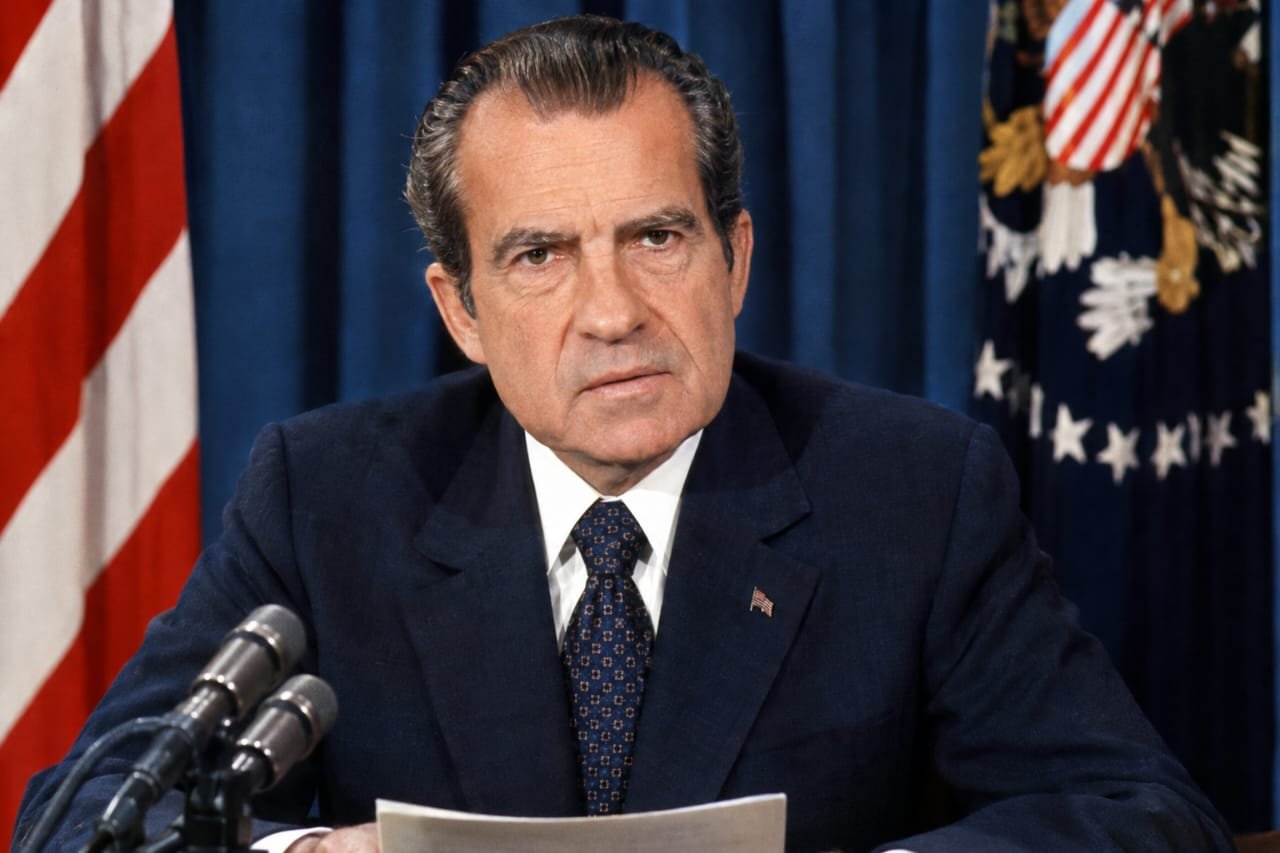
On August 8, 1974, he announced his decision in a televised address to the American people.
He explained that he no longer had a sufficiently strong political base in Congress to justify continuing in office.
Nixon’s resignation took effect at noon on August 9, 1974.
Vice President Gerald Ford was sworn in as the 38th president of the United States.
Nixon departed the White House by helicopter, bringing an extraordinary chapter in American political history to a close.
His resignation was unprecedented. No other American president had resigned from office before him, and none has done so since.
Gerald Ford and the Pardon of Nixon
One of the most controversial decisions following Watergate came in September 1974, when President Gerald Ford granted Nixon a full and unconditional pardon for any federal crimes he might have committed while president.
Ford argued that a prolonged prosecution of Nixon would keep the country divided and prevent the nation from moving forward.
However, the decision generated widespread criticism.
Some Americans believed Nixon should face prosecution like any other citizen. Others argued that the pardon protected the former president from accountability.
The pardon meant Nixon would not face federal prosecution for the covered offenses.
It did not erase the historical record of Watergate or end the wider criminal proceedings against other individuals connected to the scandal.
Several administration officials and associates were prosecuted and convicted for offenses connected to Watergate and related activities.
The controversy surrounding Ford’s decision became part of the scandal’s lasting political legacy.
Watergate fundamentally changed American politics and public attitudes toward presidential power.
1. Greater scrutiny of presidential authority
The scandal demonstrated that a president could be investigated and held accountable for misconduct. The Supreme Court’s ruling in United States v. Nixon became an important precedent concerning executive privilege and the rule of law.
2. Increased public distrust of government
The revelations damaged public confidence in the presidency and federal institutions. Watergate reinforced concerns that government officials could misuse their authority and attempt to conceal wrongdoing.
3. Congressional investigations and reforms
Congress pursued reforms intended to strengthen oversight, improve government accountability, and address weaknesses exposed by the scandal. Campaign finance rules, government ethics, and the relationship between the executive branch and Congress received increased attention.
4. Changes in political journalism
The reporting of Woodward and Bernstein became a defining example of investigative journalism. Their work demonstrated how sustained reporting, confidential sources, and documentary evidence could help expose wrongdoing by powerful public officials.
5. Criminal convictions of administration officials
Watergate resulted in criminal proceedings against several figures connected to Nixon’s administration and re-election operation. These prosecutions reinforced the distinction between political office and immunity from criminal accountability.
The scandal also influenced later debates about presidential misconduct, government secrecy, and the responsibilities of the American political system.
Conclusion
The Watergate scandal began with a burglary at the Democratic National Committee headquarters in June 1972. It developed into one of the most serious constitutional crises in American history as investigators uncovered evidence of political espionage, obstruction of justice, and attempts to conceal wrongdoing.
Journalists helped expose important connections, federal investigators pursued the evidence, congressional hearings brought the allegations before the public, and the courts required the release of crucial presidential recordings.
The decisive evidence against Richard Nixon emerged from recordings of his own conversations, particularly the June 23, 1972, discussion about restricting the FBI’s investigation.
Faced with the collapse of political support and the likelihood of impeachment and conviction, Nixon resigned on August 9, 1974.
Watergate remains a defining moment in the history of the United States because it demonstrated both the dangers of abusing presidential power and the importance of institutions capable of investigating and challenging the executive branch.
The Historabase Editorial Team is dedicated to exploring and sharing the stories that have shaped Africa and the wider world. Our work covers African history, ancient civilizations, empires, historical figures, wars, cultures, political movements, and important events from the past.
We aim to present history in a clear, engaging, and accessible way, combining historical records with careful research to help readers better understand the people, events, and civilizations that shaped our world.







One Comment