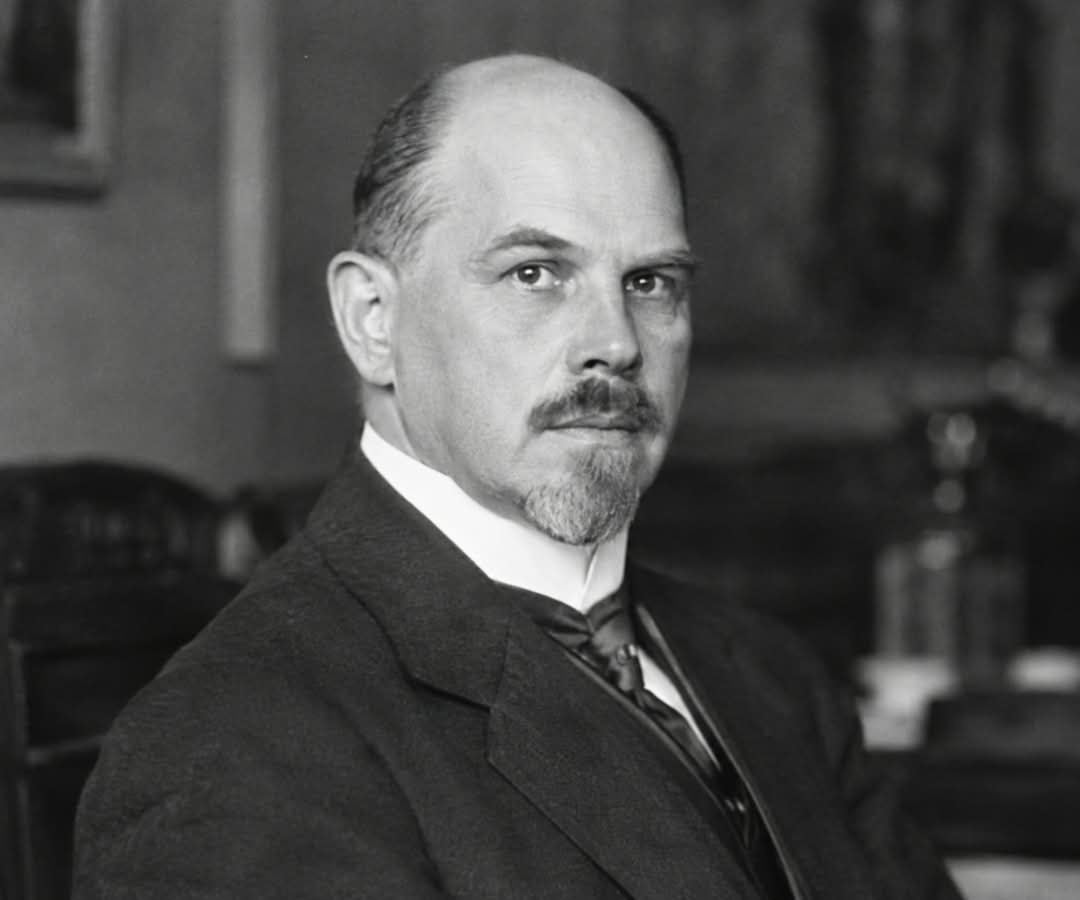
Walther Rathenau assassination. On June 24, 1922, Walther Rathenau, Germany’s foreign minister, was assassinated in Berlin by right-wing extremists who opposed the Weimar Republic and his political policies. His murder shocked Germany, intensified an already dangerous political crisis, and exposed the growing threat posed by extremist organizations to the country’s fragile democracy.
However, his Jewish background, support for the republic, and involvement in negotiations with foreign powers made him a target of antisemitic propaganda and nationalist hostility. His assassination became one of the most significant political murders of the early Weimar Republic.
Who Was Walther Rathenau?
Walther Rathenau was born on September 29, 1867, in Berlin, Prussia, into a prominent Jewish family. His father, Emil Rathenau, was an industrialist who founded the Allgemeine Elektricitäts-Gesellschaft (AEG), one of Germany’s leading electrical engineering companies.
Rathenau received an education in science and engineering before entering the industrial world. He eventually became a leading figure in German business and inherited important responsibilities within the AEG organization.
Before the First World War, Rathenau established himself as an influential industrialist and intellectual. He also wrote extensively about economics, society, politics, and Germany’s place in the modern world.
When the First World War began in 1914, Rathenau recognized the importance of organizing Germany’s industrial resources to sustain the war effort. He helped establish the War Raw Materials Department within the Prussian Ministry of War, which coordinated the distribution of essential materials needed by German industries and the military.
His work during the war increased his influence within government and industry.
Following Germany’s defeat in 1918, Rathenau became involved in the political and economic challenges facing the newly established democratic government.
Germany After the First World War
Germany’s defeat in the First World War brought the collapse of the German Empire. In November 1918, Kaiser Wilhelm II abdicated, and the country moved toward a republican system of government.
The new political order became known as the Weimar Republic, named after the city where the National Assembly met to establish Germany’s new constitutional framework.
The republic faced enormous difficulties from its beginning. Germany had suffered military defeat, economic disruption, political unrest, and social division. Revolutionary movements on the left and nationalist organizations on the right challenged the authority of the new government.
The signing of the Treaty of Versailles in June 1919 further intensified political tensions.
Under the treaty, Germany accepted responsibility for the war under Article 231, faced territorial losses, agreed to military restrictions, and became liable for reparations.
Many German nationalists regarded the treaty as humiliating. They accused republican politicians of betraying the country by accepting its terms.
Extremist groups promoted the false claim that Germany had not truly been defeated on the battlefield but had instead been betrayed by politicians and other supposed internal enemies. Antisemitic propaganda frequently incorporated Jews into these accusations.
Rathenau became a particular target of this hostility because he was Jewish, supported the republican government, and advocated practical negotiations with Germany’s former enemies.
Rathenau’s Role in the Weimar Republic
Following the war, Rathenau became increasingly involved in Germany’s economic and diplomatic affairs.
In 1921, he served as minister for reconstruction in the government of Chancellor Joseph Wirth. His responsibilities included addressing economic problems resulting from the war and the obligations imposed on Germany under the postwar settlement.
In January 1922, Rathenau became Germany’s foreign minister.
His appointment came at a difficult time. Germany faced international isolation, disputes over reparations, and strained relations with the Allied powers.
Rathenau believed that Germany needed to restore its international position through diplomacy and economic cooperation. Although he did not support every provision of the Treaty of Versailles, he considered negotiations necessary to improve Germany’s circumstances.
His willingness to pursue agreements with foreign governments angered nationalist opponents who demanded a more confrontational approach.
For these opponents, Rathenau represented the republican political establishment they wanted to overthrow.
His position as foreign minister also made him a highly visible target for political propaganda.
The Treaty of Rapallo and Rising Hostility
One of Rathenau’s most important diplomatic achievements was the Treaty of Rapallo, signed on April 16, 1922.
The agreement was concluded between Germany and Soviet Russia during the international economic conference held in Genoa, Italy.
Both countries had experienced international isolation following the First World War and the Russian Revolution. The treaty provided for the restoration of diplomatic relations, mutual renunciation of certain financial claims, and the development of economic relations between the two countries.
The agreement represented an important diplomatic development for Germany.
However, it also generated suspicion among other European governments. Some feared that cooperation between Germany and Soviet Russia could undermine the postwar European settlement.
German nationalist opponents attacked the treaty for different reasons. Rathenau’s critics portrayed his diplomacy as evidence that the republican government was pursuing policies contrary to German national interests.
Antisemitic extremists also used the treaty to spread conspiracy theories about Jewish influence in German politics and international affairs.
These accusations were part of a broader campaign against Rathenau. His Jewish identity made him a prominent target of antisemitism, while his political position exposed him to threats from radical nationalist organizations.
By the spring of 1922, political hostility toward Rathenau had become increasingly dangerous.
The Assassination of Walther Rathenau
On the morning of June 24, 1922, Rathenau left his residence in Berlin to travel to the Foreign Office.
He was travelling in an open-top automobile through the Grunewald district when the attackers approached his vehicle.
The assassination was carried out by right-wing extremists associated with the Organisation Consul, a clandestine nationalist and antisemitic organization involved in political violence against the Weimar Republic.
The principal assassins were Erwin Kern and Hermann Fischer. Ernst Werner Techow assisted the operation by driving the automobile used by the attackers.
As Rathenau’s car travelled along the road, the assailants drove alongside it. Kern fired shots at Rathenau with a submachine gun, while Fischer threw a hand grenade into the vehicle.
Rathenau was fatally wounded in the attack.
The assassins escaped from the scene, leaving the foreign minister dead in his automobile.
His murder was not an isolated act of political violence. It occurred amid a wider campaign of assassinations and attacks against republican politicians and public figures by extremist nationalists who rejected Germany’s postwar democratic government.
The killing of a serving foreign minister demonstrated how far political violence had penetrated the country’s public life.
Who Planned the Murder?
The assassination was connected to the Organisation Consul, a secret nationalist network that emerged from the remnants of right-wing paramilitary groups following the First World War.
The organization opposed the Weimar Republic and sought to destroy the republican political order through intimidation, conspiracy, and targeted killings.
Its members included former soldiers and individuals associated with nationalist and antisemitic movements.
The organization had been involved in other political assassinations. In August 1921, Matthias Erzberger, a former finance minister and a prominent supporter of the armistice that ended Germany’s participation in the First World War, was murdered by right-wing extremists associated with the same broader network.
Rathenau’s assassination followed a similar pattern of violence directed against politicians regarded by nationalists as responsible for Germany’s defeat or the country’s postwar settlement.
Investigations identified the men involved in the murder and their connections to extremist circles.
Erwin Kern and Hermann Fischer fled after the assassination. In July 1922, police located them at Saaleck Castle in Thuringia. During the confrontation, Kern was killed, while Fischer died by suicide.
Ernst Werner Techow was arrested and brought to trial. He was convicted for his role in the assassination and sentenced to prison.
The investigation and subsequent legal proceedings exposed connections between the murderers and the wider extremist movement opposed to the Weimar Republic.
The Historabase Editorial Team is dedicated to exploring and sharing the stories that have shaped Africa and the wider world. Our work covers African history, ancient civilizations, empires, historical figures, wars, cultures, political movements, and important events from the past.
We aim to present history in a clear, engaging, and accessible way, combining historical records with careful research to help readers better understand the people, events, and civilizations that shaped our world.








One Comment