In the early 19th century, southern Africa experienced a period of major political and social transformation. Among the most important developments was the rise of the Zulu Kingdom, which grew from a relatively small chiefdom into one of the most powerful states in the region.
At the centre of this transformation was Shaka kaSenzangakhona, better known as Shaka Zulu. During his short reign from 1816 to 1828, Shaka reorganised the Zulu state, transformed its military and expanded its influence across much of present-day KwaZulu-Natal.
The Early Life of Shaka Zulu
Shaka was born around 1787, the son of Senzangakhona, chief of the Zulu people, and Nandi. His childhood was reportedly difficult, and traditional accounts describe him as facing rejection and hardship.
As a young man, Shaka became associated with the Mthethwa kingdom under the powerful leader Dingiswayo. There, he gained military experience and developed ideas that would later transform the Zulu army.
At the time, the region was made up of numerous independent Nguni-speaking chiefdoms. Some were becoming increasingly powerful and competing for territory, cattle, trade and political influence.
Shaka Becomes King
When Shaka’s father died around 1816, Shaka returned to the Zulu chiefdom with support from Dingiswayo. He defeated his rival and became the Zulu chief.
However, Shaka was not satisfied with ruling a small chiefdom.
He began expanding Zulu territory by defeating neighbouring groups and incorporating their people into his growing state. His victories increased both the size of his army and the resources available to the Zulu leadership.
The Transformation of the Zulu Army
One of Shaka’s greatest achievements was his reorganisation of warfare.
He developed a highly disciplined military system based around age-group regiments known as amabutho. Young men were organised into units that could be mobilised by the king.
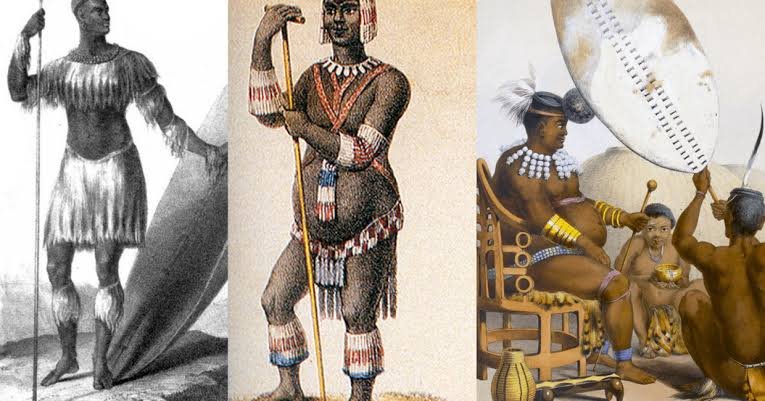
Shaka also emphasised close combat. His warriors became associated with the iklwa, a short stabbing spear designed for fighting at close range, while large shields were used for protection.
Instead of relying primarily on throwing spears from a distance, Shaka trained his warriors to move aggressively towards the enemy and engage at close quarters.
His army used coordinated tactics, including the famous “horns of the buffalo” formation, in which forces attempted to surround an opponent from several directions.
These military reforms helped turn the Zulu army into a highly effective fighting force.
The Expansion of the Zulu Kingdom
Shaka’s expansion accelerated after the death of Dingiswayo around 1818.
The powerful Ndwandwe state, led by Zwide, became one of Shaka’s major rivals. Shaka’s forces defeated the Ndwandwe in a series of battles, including a major victory at the Mhlathuze River.
Following these victories, many defeated communities were incorporated into the growing Zulu state. Others fled the region, contributing to wider migrations and conflicts across southern Africa.
Within little more than a decade, Shaka had transformed the Zulu from a relatively small chiefdom into a centralised kingdom with influence stretching across a large part of southeastern Africa.
The Mfecane and Its Controversies
Shaka’s expansion is often linked to the Mfecane, a period of warfare, political upheaval and migration in southern Africa during the early 19th century.
For many years, historical accounts portrayed Shaka’s conquests as the main cause of this widespread disruption. Modern historians, however, have questioned this simple explanation.
Competition for land and resources, changing trade networks, drought, political rivalries and conflicts among several African states also contributed to the upheaval. Some historians argue that the Mfecane had begun before Shaka’s reign and that his role has sometimes been exaggerated.
Nevertheless, there is little doubt that Zulu expansion had significant consequences for neighbouring communities.
Shaka’s Later Years
Despite his military achievements, Shaka’s rule became increasingly authoritarian.
His power was highly centralised, and his decisions could determine the lives of thousands of people. The death of his mother, Nandi, in 1827 reportedly had a particularly severe impact on his behaviour and contributed to further executions and instability.
At the same time, Shaka maintained contact with European traders who arrived at Port Natal. He showed interest in European technology and trade and allowed foreign traders to establish a settlement in the area.
The Death of Shaka
Shaka’s reign came to a violent end in September 1828.
His half-brothers Dingane and Mhlangana, together with an associate, participated in a plot against him. Shaka was assassinated near his royal settlement at Dukuza.
He was about 40 years old.
After his death, Dingane became king and inherited the powerful kingdom Shaka had created.
The Legacy of Shaka Zulu
Shaka ruled for only about twelve years, but his impact on southern African history was enormous.
He transformed the Zulu from a small chiefdom into a powerful centralised kingdom, introduced major military reforms and reshaped the political balance of the region.
His legacy is complex. He is remembered as a brilliant military organiser and nation-builder, but also as a ruthless ruler whose wars contributed to considerable suffering and displacement.
The Zulu Kingdom survived his death and remained an important political power for decades. Its later confrontation with British colonial expansion, particularly during the Anglo-Zulu War of 1879, would become another major chapter in African history.
Shaka’s story therefore represents both the power of political transformation and the human cost that can accompany the creation of a powerful state.
The Historabase Editorial Team is dedicated to exploring and sharing the stories that have shaped Africa and the wider world. Our work covers African history, ancient civilizations, empires, historical figures, wars, cultures, political movements, and important events from the past.
We aim to present history in a clear, engaging, and accessible way, combining historical records with careful research to help readers better understand the people, events, and civilizations that shaped our world.