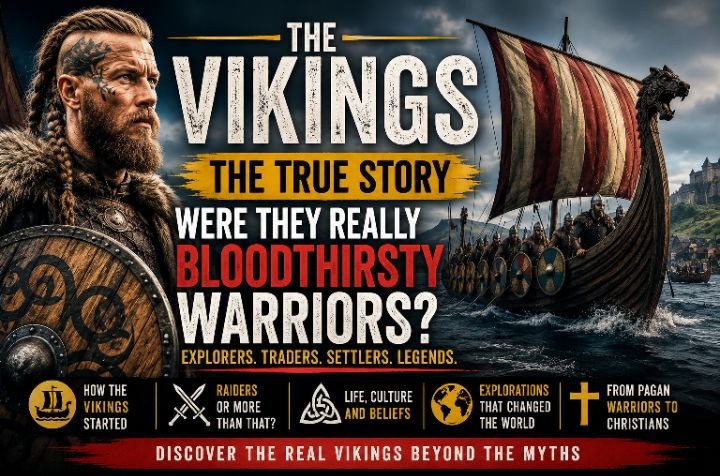
For centuries, the Vikings have been remembered as terrifying warriors who sailed across the seas, raided villages, burned monasteries and fought their enemies with brutal determination. Popular films, television shows and video games have strengthened this image, often portraying Vikings as fearless warriors whose lives revolved around violence and conquest.
The Vikings were certainly capable of extraordinary violence, and raiding was an important part of their expansion. However, they were also farmers, traders, explorers, craftsmen, settlers, politicians and shipbuilders. They established communities across Europe and beyond, founded trading centres, influenced kingdoms and travelled farther than many people of their time.
So, who were the Vikings, where did they come from, and how did they become one of the most influential groups in medieval history?
Who Were the Vikings?
The word “Viking” did not refer to a single nation or ethnic group.
The people we call Vikings came primarily from Scandinavia, especially modern-day Denmark, Norway and Sweden. They spoke related North Germanic languages and shared many cultural and religious traditions.
The term “Viking” was more closely associated with an activity than with an entire population. Some Scandinavians went “on Viking” by participating in overseas raids, trading expeditions or military campaigns. Others remained at home and lived ordinary lives as farmers, fishermen, craftsmen and merchants.
This distinction is important.
Not every Scandinavian living during the Viking Age was a Viking warrior.
The Viking Age is generally dated from around 793 to 1066, although Scandinavian overseas activity began before 793 and continued beyond that period.
How Did the Vikings Start?
The Vikings did not suddenly appear as a new people in the eighth century. Their societies developed over centuries in northern Europe.
Before the Viking Age, Scandinavians lived in small farming and trading communities. They cultivated crops, raised livestock, fished and hunted. Coastal communities also developed strong maritime traditions because the geography of Scandinavia encouraged travel by sea.
The region contained mountains, forests, islands, fjords and long coastlines. In many areas, travelling by water was easier than travelling over land.
This environment helped Scandinavian societies become exceptional sailors.
By the early Viking Age, Scandinavian craftsmen had developed advanced shipbuilding techniques. Their ships were light, fast and capable of travelling both in open seas and shallow rivers.
That technology would eventually allow Scandinavian warriors and merchants to reach places as far away as North America, the Middle East and North Africa.
Why Did the Vikings Begin Raiding?
Historians do not believe there was one single reason why Viking raids began.
Several factors probably contributed.
One was the development of powerful ships. Scandinavians suddenly possessed vessels that could carry warriors across the North Sea and quickly return home.
Economic opportunities were another factor.
European monasteries and wealthy settlements contained valuable goods, including silver, gold, weapons, jewellery and religious objects. Some coastal communities were poorly defended, making them attractive targets.
Political changes may also have played a role.
Scandinavia was experiencing increasing competition among local rulers and powerful families. Ambitious leaders could gain wealth and prestige through successful overseas expeditions.
Population growth, competition for resources and opportunities for trade and settlement may also have encouraged expansion.
Rather than one simple explanation, the Viking expansion was probably the result of several factors coming together: technology, wealth, politics, geography and opportunity.
793: The Raid That Shocked Europe
The date most commonly used to mark the beginning of the Viking Age is 793, when a Scandinavian raid struck the monastery of Lindisfarne off the northeastern coast of England.
Lindisfarne was an important Christian religious centre.
The attack shocked contemporary Christian Europe.
Monasteries were not normally built as military fortresses, and they contained valuable religious objects and other wealth. The attackers could arrive by sea, strike quickly and escape before a large army could respond.
The Lindisfarne raid became famous because of the fear it created.
However, it is important to understand that Viking activity did not begin with Lindisfarne. Scandinavians had already been travelling, trading and raiding in northern Europe.
Lindisfarne simply became one of the most famous early attacks recorded by Christian writers.
The Vikings Were More Than Raiders
The image of Vikings as constant raiders is one of the biggest misconceptions about them.
Raiding was important, but it was only one part of Viking society.
Many Vikings were farmers.
They grew crops, raised animals and lived in settlements with their families. Others were blacksmiths, carpenters, merchants, fishermen and shipbuilders.
Trade was particularly important.
Scandinavian merchants travelled throughout Europe and established connections stretching from the Atlantic Ocean to the Middle East.
They traded goods such as furs, timber, amber, iron and walrus ivory. In return, they obtained silver, silk, spices, glass and other valuable products.
Some Scandinavian traders travelled along the rivers of Eastern Europe and reached major centres such as Constantinople, the capital of the Byzantine Empire.
Others travelled west toward Britain, Ireland and the North Atlantic.
The Vikings were therefore part of a much larger medieval trading network.
The Vikings as Explorers
Perhaps the most remarkable part of Viking history is their exploration.
Norwegian Vikings established settlements in Iceland during the ninth century.
From Iceland, Norse explorers travelled farther west.
Erik the Red established a Norse settlement in Greenland in the late tenth century.
His son, Leif Erikson, is traditionally associated with the Norse exploration of a land called Vinland, generally believed to have been somewhere along the coast of North America.
Archaeological evidence at L’Anse aux Meadows in Newfoundland confirms that Norse people established a settlement in North America around a thousand years ago.
This means Europeans reached North America centuries before Christopher Columbus’s famous 1492 voyage.
The Vikings achieved this using relatively simple navigational technology combined with remarkable knowledge of the sea, weather and landscape.
The Vikings in Britain and Ireland
Britain became one of the most important areas of Viking expansion.
After the first raids, Scandinavian forces increasingly began establishing permanent settlements.
In the ninth century, the Great Heathen Army invaded England. Anglo-Saxon kingdoms fought against the Viking forces, with King Alfred of Wessex becoming one of the most important opponents of Viking expansion.
Eventually, large parts of England came under Scandinavian influence.
The region controlled by the Vikings became known as the Danelaw.
Viking influence also became significant in Ireland and Scotland. Norse settlers established communities and trading centres, including Dublin, which developed into an important medieval settlement.
The Vikings did not simply destroy these societies. Over time, they became part of them.
They married local people, adopted Christianity and participated in political and economic life.
The Vikings in Eastern Europe
Swedish Vikings followed a different route.
Known in many eastern sources as Rus, Scandinavian traders and warriors travelled through the rivers of modern-day Russia, Ukraine and Belarus.
They established or became involved in important centres such as Novgorod and Kyiv.
These networks connected Scandinavia with the Byzantine Empire and the Islamic world.
Some Scandinavian warriors even served as elite soldiers in the Byzantine emperor’s army. They became known as the Varangian Guard.
This demonstrates just how far Viking networks reached.
A Viking could potentially travel from Scandinavia through Eastern Europe, reach Constantinople and enter a world completely different from the villages and fjords of northern Europe.
Were Vikings Really Bloodthirsty?
The answer is both yes and no.
Viking warriors could be extremely violent.
Raids involved killing, kidnapping, destruction and enslavement. Monasteries and settlements were attacked, and captives could be sold or forced into servitude.
The Viking slave trade was significant. Enslaved people were transported through European and eastern trading networks, and some were taken to markets in the Islamic world.
So it would be wrong to completely dismiss the historical evidence of Viking violence.
However, the image of Vikings as uniquely bloodthirsty is misleading.
Medieval Europe was already a violent society. Warfare, slavery, political assassinations and raids existed long before and after the Viking Age.
Much of what we know about Viking raids comes from Christian writers who viewed the attackers as pagan enemies.
Their accounts understandably focused on the horror and destruction caused by the raids.
Archaeology and other sources provide a broader picture.
The Vikings were not a civilization dedicated exclusively to killing.
They were complex societies in which violence existed alongside farming, trade, law, family life, religion and diplomacy.
Viking Society and Women
Viking society was also more complicated than popular culture suggests.
Women generally had different social roles from men, but they could have significant responsibilities within households and communities.
Women could manage farms and property when their husbands were away. In some circumstances, they could own property, inherit wealth and seek divorce.
Archaeological discoveries have also challenged assumptions about Viking gender roles.
There is evidence that some women participated in activities traditionally associated with warriors, although historians continue to debate the extent and nature of female participation in warfare.
The famous image of armies filled with female Viking warriors should therefore be treated cautiously.
The historical evidence suggests a society with defined gender expectations but also more complexity than the stereotype suggests.
Viking Religion
Before Christianity became dominant, most Vikings followed a religion based on Norse gods.
Among the best-known were Odin, associated with wisdom, war and death; Thor, associated with thunder and protection; and Freyja, associated with fertility, love and other aspects of life.
The Vikings believed in multiple worlds and a complex supernatural order.
Valhalla, often portrayed in modern entertainment as a simple Viking heaven, was traditionally associated with warriors chosen by Odin who died in battle.
Religion influenced Viking rituals, politics and ideas about honour.
However, Christianity gradually spread through Scandinavia.
By the eleventh century, most Scandinavian kingdoms had officially embraced Christianity.
The conversion did not happen overnight. Pagan traditions survived for generations, and Christian and Norse beliefs sometimes existed side by side.
Viking Ships: The Secret Behind Their Success
The Viking Age would have been impossible without ships.
Their famous longships were technological masterpieces for their time.
They were designed to be fast, flexible and relatively light. Many could travel through shallow water, allowing Viking forces to move up rivers and attack places far inland.
This gave Viking armies an enormous strategic advantage.
Their ships could also cross rough seas, allowing Scandinavians to travel between distant regions.
The combination of speed, mobility and surprise made Viking raids particularly difficult to defend against.
Their shipbuilding skills were therefore one of the most important reasons behind their expansion.
How the Viking Age Ended
The Viking Age did not end because the Vikings suddenly disappeared.
Christianity became dominant. Kings consolidated their authority and created stronger centralized states.
European kingdoms also became better organized and more capable of defending themselves.
As Christianity spread, Viking raids on Christian monasteries became politically and culturally different from earlier campaigns.
By the eleventh century, Scandinavian rulers were increasingly behaving like European Christian monarchs rather than leaders of loosely organized pagan warrior societies.
The year 1066 is often used as a symbolic ending point.
That year, Norwegian King Harald Hardrada invaded England but was defeated and killed at the Battle of Stamford Bridge.
Only a few weeks later, William the Conqueror invaded England from Normandy and defeated the English at the Battle of Hastings.
Interestingly, William himself was descended from Scandinavian settlers. The Viking legacy had already become deeply connected with European political history.
The Lasting Legacy of the Vikings
The Vikings left an enormous legacy.
Their descendants helped shape kingdoms in Scandinavia, Britain, Ireland, Eastern Europe and the North Atlantic.
Their language influenced English. Hundreds of words and place names in Britain have Scandinavian origins.
Viking settlements also contributed to the development of major trading centres.
Their exploration connected distant parts of the North Atlantic world, while their trading networks linked Scandinavia with Europe and the Middle East.
Their stories survived through sagas, legends, archaeological discoveries and historical records.
Today, Vikings remain one of the most recognizable cultures of the medieval world.
But the real story is more interesting than the stereotype.
So, Were the Vikings Really Bloodthirsty Warriors?
The Vikings were warriors, and their raids could be brutal. They killed, enslaved and conquered people, and their attacks caused genuine fear throughout medieval Europe.
But they were not simply bloodthirsty barbarians.
They were also farmers, traders, explorers, craftsmen, settlers, sailors and political leaders.
They built sophisticated ships, developed extensive trading networks, established settlements across the North Atlantic and played important roles in the development of several European kingdoms.
The Viking story is therefore not simply a story of violence.
It is a story of movement, ambition, technology, trade, exploration and cultural transformation.
The Vikings changed the medieval world not only with their swords, but also with their ships, markets, settlements and ideas.
Their greatest achievement may not have been the kingdoms they conquered, but the vast network of connections they created across Europe and the North Atlantic.
The Historabase Editorial Team is dedicated to exploring and sharing the stories that have shaped Africa and the wider world. Our work covers African history, ancient civilizations, empires, historical figures, wars, cultures, political movements, and important events from the past.
We aim to present history in a clear, engaging, and accessible way, combining historical records with careful research to help readers better understand the people, events, and civilizations that shaped our world.