The Hundred Years’ War was one of the longest and most important conflicts of medieval Europe. Fought mainly between England and France from 1337 to 1453, the war lasted for more than a century, although fighting was interrupted by long periods of peace and truces.
The conflict was not simply one continuous war. It was a series of battles, political struggles, territorial disputes and succession crises that gradually transformed both England and France.
But why did England and France fight for so long? The answer lies in a complicated mixture of royal succession, control of territory, economic interests, political rivalry and national identity.
How Did the Hundred Years’ War Begin?
The immediate cause of the war was a dispute over the French throne.
When King Charles IV of France died in 1328 without a surviving son, the direct male line of the French Capetian dynasty came to an end. The English king, Edward III, believed he had a claim to the French crown through his mother, Isabella of France, who was the sister of Charles IV.
However, the French nobility rejected Edward’s claim. Instead, they supported Philip of Valois, who became King Philip VI.
The French argued that the crown could not pass through the female line. Edward III eventually accepted Philip as king, but the dispute remained unresolved.
Relations deteriorated further because Edward III was also a powerful French vassal. He held territories in France, particularly Gascony, and was technically required to recognize the French king as his superior in those lands.
Edward increasingly resisted French authority. In 1337, Philip VI confiscated Gascony, and Edward responded by asserting his claim to the French throne.
This marked the beginning of the Hundred Years’ War.
England’s Ambitions in France
England’s goals changed throughout the conflict.
At first, Edward III wanted to protect his possessions in France and strengthen his position as a major European ruler. His claim to the French crown eventually became central to the conflict.
France was wealthy, strategically important and politically divided. Controlling French territory offered enormous advantages.
For England, territories in France also provided economic benefits. Gascony, for example, was important for the wine trade. English merchants had strong commercial interests in the region.
The English monarchy therefore had both political and economic reasons to defend its French possessions.
The English Victories
The early stages of the war brought remarkable victories for England.
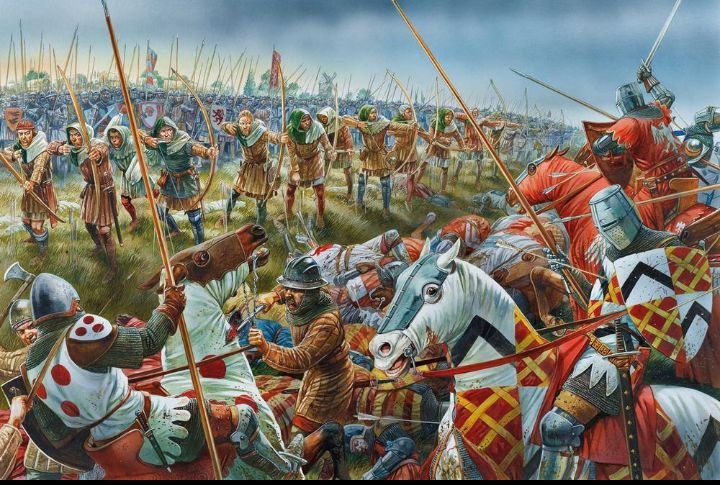
One of the most famous was the Battle of Crécy in 1346. The English army, commanded by Edward III, defeated a much larger French force.
English longbowmen played an important role in the victory. Their ability to fire large numbers of arrows helped disrupt French attacks and contributed to the defeat of heavily armoured knights.
Another major English victory came at the Battle of Poitiers in 1356.
The English, led by Edward, the Black Prince, defeated the French and captured King John II of France.
The capture of the French king was a major political disaster for France. It demonstrated how vulnerable the French monarchy had become.
The conflict eventually produced the Treaty of Brétigny in 1360, under which Edward III temporarily gave up his claim to the French crown in exchange for extensive territories and greater independence for English-controlled lands in France.
For a time, it appeared that England had achieved a major victory.
Why Did the War Continue?
The Treaty of Brétigny did not create lasting peace.
Both sides continued to distrust each other, and disputes over territory remained unresolved.
When Charles V of France became king, France began rebuilding its military strength. Rather than confronting the English directly in large battles, Charles used a more cautious strategy.
French forces gradually recovered territory from the English.
By the late 14th century, much of the land England had gained earlier in the war had been lost.
A temporary period of peace followed, but the underlying rivalry remained.
Henry V and the English Revival
The conflict entered another major phase when Henry V became king of England in 1413.
Henry revived England’s claim to the French throne and invaded France in 1415.
His most famous victory came at the Battle of Agincourt.
The English army was heavily outnumbered, exhausted and suffering from poor conditions. Yet Henry’s forces defeated a much larger French army.
The victory became one of the most famous military achievements in English history.
Henry’s success eventually led to the Treaty of Troyes in 1420. Under its terms, Henry was recognized as heir to the French throne and married Catherine of Valois, the daughter of King Charles VI.
It appeared that England might finally gain control of France.
But Henry V died in 1422, before he could become king of France.
His infant son, Henry VI, inherited the English and French claims.
That created another major problem.
Joan of Arc Changes the War
The French position seemed desperate, but a remarkable figure emerged: Joan of Arc.
Joan was a young French peasant who believed she had been chosen to help defend France.
In 1429, she played a crucial role in raising French morale and helping French forces lift the Siege of Orléans.
Her victories helped restore confidence in the French cause.
Joan also helped support the coronation of Charles VII at Reims.
Although Joan was eventually captured by forces allied with the English and executed in 1431, her role had already become symbolic.
She helped transform the conflict from a struggle between rival monarchies into a powerful cause associated with French identity.
France Slowly Takes Back Its Territory
After Joan of Arc’s intervention, France continued to strengthen.
Charles VII reorganized the French military and developed more effective forces, including permanent troops and improved artillery.
The English position became increasingly difficult.
England faced financial problems and political instability. Maintaining armies across the English Channel was expensive, while France had a much larger population and greater resources.
French forces gradually recovered territories that had been controlled by England.
Major French victories followed, including the Battle of Formigny in 1450 and the Battle of Castillon in 1453.
Castillon is traditionally regarded as the final battle of the Hundred Years’ War.
The French victory effectively ended English ambitions in mainland France.
What Did England Lose?
By 1453, England had lost almost all of its French territories.
The major exception was Calais, which remained under English control until 1558.
England’s original ambition of ruling France had failed.
France, however, emerged from the conflict with a stronger monarchy and greater territorial unity.
The war also changed the balance of power in Western Europe.
Was It Really a Hundred Years of Fighting?
Despite its name, the Hundred Years’ War was not a continuous 116-year battle.
The conflict lasted from 1337 to 1453, but there were several long periods of peace, truces and limited fighting.
Historians use the term “Hundred Years’ War” to describe the broader series of conflicts between the English and French monarchies during this period.
It is therefore better understood as a long political and military struggle rather than one uninterrupted war.
How the War Changed Warfare
The Hundred Years’ War also helped transform medieval warfare.
The traditional dominance of heavily armoured knights began to decline.
Weapons such as the English longbow and increasingly powerful artillery demonstrated that armies could defeat traditional cavalry forces through different tactics and technology.
The French eventually developed stronger artillery forces, which became particularly important during the final stages of the conflict.
These developments helped move European warfare away from the traditional medieval model.
The Rise of French National Identity
Perhaps one of the war’s most important long-term effects was the development of a stronger sense of French identity.
At the beginning of the conflict, political loyalty was often connected more to individual lords and dynasties than to the modern concept of a nation.
Over time, however, the English invasion encouraged many French communities to identify more strongly with the French monarchy and the idea of defending France.
Joan of Arc became an enduring symbol of this transformation.
The English also developed a stronger sense of political identity during the conflict, although England’s connection to France remained complicated for centuries.
Why Did the War Last So Long?
There was no single reason.
The conflict continued for so long because several problems reinforced one another:
1. The French throne: Edward III’s claim created a major dispute over who had the right to rule France.
2. Territory: England wanted to protect and expand its possessions in France, while French kings wanted to recover them.
3. Economic interests: Regions such as Gascony were valuable because of trade and resources.
4. Political rivalry: England and France were competing for influence in Western Europe.
5. Weak periods of peace: Treaties often stopped the fighting without solving the underlying disputes.
6. Dynastic ambitions: Medieval kings viewed territory and royal succession as matters of enormous importance.
7. Military changes: Both sides developed new tactics and weapons, allowing the conflict to continue even after major defeats.
The Legacy of the Hundred Years’ War
The Hundred Years’ War ended with France firmly in the stronger position.
England had lost almost all of its possessions in France, while the French monarchy had expanded its authority and strengthened its military organization.
The conflict also left a deep mark on European history. It helped weaken the political power of feudal nobles, strengthened centralized monarchies and contributed to changes in warfare.
Most importantly, the war demonstrated that medieval conflicts could be driven by far more than battlefield victories. Royal succession, economics, territory and political identity could keep two kingdoms fighting for generations.
The Hundred Years’ War began as a dispute over who should sit on the French throne. More than a century later, it ended with a transformed France, a humbled England and a Europe entering a new political age.
Conclusion
The Hundred Years’ War lasted so long because neither England nor France could easily abandon its ambitions. Kings changed, treaties were signed and armies were defeated, but the fundamental struggle over territory, power and the French crown remained.
The Historabase Editorial Team is dedicated to exploring and sharing the stories that have shaped Africa and the wider world. Our work covers African history, ancient civilizations, empires, historical figures, wars, cultures, political movements, and important events from the past.
We aim to present history in a clear, engaging, and accessible way, combining historical records with careful research to help readers better understand the people, events, and civilizations that shaped our world.