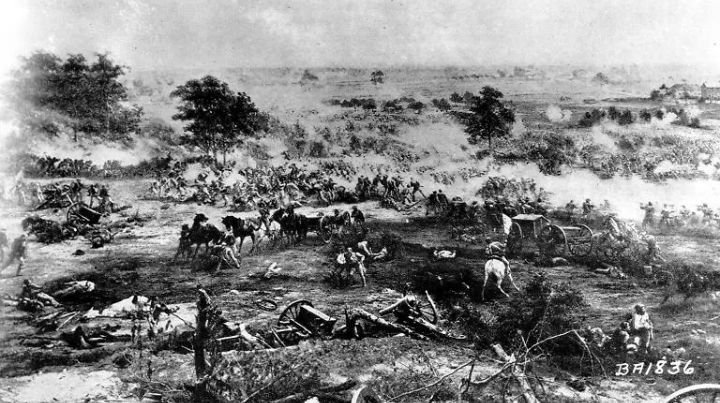
The American Civil War was one of the most consequential conflicts in United States history. Fought from 1861 to 1865, the war divided the country between the United States government, commonly known as the Union, and eleven Southern states that seceded to form the Confederate States of America.
More than 600,000 soldiers are estimated to have died from combat, disease, and other causes, making the Civil War one of the deadliest conflicts in American history.
But what caused the war?
The answer cannot be reduced to a single event. Decades of political, economic, and social tensions had divided the United States, but slavery and the struggle over its expansion were at the center of the crisis. Disputes over states’ rights, federal authority, territorial expansion, and political power intensified the conflict until compromise eventually collapsed.
Understanding the causes of the American Civil War requires looking at how these tensions developed over several decades.
Slavery at the Center of the Conflict
The most important issue behind the Civil War was slavery.
By the middle of the 19th century, millions of African Americans were enslaved in the Southern states. The Southern economy depended heavily on agriculture, particularly the production of cotton, tobacco, sugar, and other crops.
Cotton became especially important after the invention of the cotton gin made processing cotton more efficient. As cotton production expanded, so did the demand for enslaved labor.
Southern slaveholders defended slavery as an essential part of their economic and social system. Many also developed political and racial arguments intended to justify the institution.
In contrast, opposition to slavery grew in many parts of the Northern United States.
Not every Northerner was an abolitionist, and many Americans disagreed about what should be done with slavery. However, an increasingly powerful abolitionist movement demanded an end to slavery.
The disagreement became particularly explosive when Americans debated whether slavery should be permitted in new territories and states.
The Expansion of the United States
As the United States expanded westward, a major question emerged:
Would slavery be allowed in the new territories?
This question was crucial because the balance of power between free and slave states affected representation in Congress.
Every new state potentially changed the political balance between the North and South.
The territories acquired after the Mexican-American War of 1846–1848 made the issue even more urgent.
Southern politicians feared that the creation of additional free states would eventually leave them politically powerless at the federal level.
Northern antislavery politicians, meanwhile, increasingly opposed the expansion of slavery into western territories.
The struggle over expansion therefore transformed slavery from a regional institution into a national political crisis.
The Missouri Compromise
The tensions over slavery were already visible decades before the Civil War.
In 1820, Congress passed the Missouri Compromise.
Missouri entered the Union as a slave state, while Maine entered as a free state, preserving the political balance between the two sides.
The compromise also established restrictions on slavery in parts of the Louisiana Purchase territory.
For a time, the agreement helped reduce tensions.
But it did not solve the fundamental problem.
The country continued to expand, and every new territory raised the same question about slavery.
The Missouri Compromise ultimately became an example of America’s temporary solutions to a problem that was becoming increasingly difficult to contain.
The Compromise of 1850
The acquisition of large western territories following the Mexican-American War created another crisis.
California sought admission to the Union as a free state, threatening the existing balance between free and slave states.
Congress responded with the Compromise of 1850.
California entered as a free state, while other measures addressed slavery in the territories and strengthened the federal government’s ability to recover escaped enslaved people.
One of the most controversial parts was the Fugitive Slave Act of 1850.
The law required authorities in free states to assist in the return of escaped enslaved people.
Many Northerners strongly opposed the law, particularly because it allowed alleged escapees to be returned to slavery without the legal protections that many believed they deserved.
Instead of permanently settling the dispute, the compromise increased political and moral tensions between North and South.
The Fugitive Slave Issue
The question of escaped enslaved people became another major source of conflict.
Enslaved people escaping from Southern states sometimes sought freedom in Northern states or Canada.
A network known as the Underground Railroad helped some escape slavery.
Abolitionists and other antislavery activists assisted fugitives, while Southern slaveholders demanded stronger federal enforcement.
The Fugitive Slave Act intensified the dispute because it made the issue a national responsibility.
Northern resistance to the law convinced many Southern leaders that the North was becoming increasingly hostile to the Southern social order.
The Rise of Abolitionism
During the 1830s and 1840s, abolitionism became more influential.
Figures such as William Lloyd Garrison publicly demanded the immediate abolition of slavery.
Formerly enslaved people, including Frederick Douglass, became powerful voices against slavery.
Douglass used speeches, newspapers, and books to expose the realities of slavery and argue for African American freedom and citizenship.
Abolitionists remained a minority in many parts of the country, but their influence grew.
Southern leaders viewed the movement as a direct threat to slavery.
The political debate became increasingly emotional, with each side accusing the other of attempting to destroy the nation’s constitutional system.
The Kansas-Nebraska Act
Another major turning point came in 1854 with the Kansas-Nebraska Act.
The legislation allowed settlers in the Kansas and Nebraska territories to decide whether slavery would be permitted through a principle known as popular sovereignty.
This effectively overturned the slavery restrictions established by the Missouri Compromise.
Pro-slavery and antislavery settlers flooded into Kansas, each attempting to influence the territory’s future.
The resulting conflict became known as Bleeding Kansas.
Armed clashes and political violence demonstrated that compromise was becoming increasingly difficult.
Kansas became a preview of the larger conflict that would soon engulf the country.
The Formation of the Republican Party
The Kansas-Nebraska Act also contributed to the emergence of a new political force: the Republican Party.
Founded in the 1850s, the Republican Party brought together people who opposed the expansion of slavery into the western territories.
The party did not initially represent a single position on abolishing slavery everywhere, but it strongly opposed allowing slavery to spread into new territories.
Its rise alarmed many Southern politicians.
The possibility that a political party opposed to slavery’s expansion could control the federal government convinced some Southern leaders that their influence within the Union was declining.
The Dred Scott Decision
In 1857, the United States Supreme Court issued a controversial ruling in the case of Dred Scott v. Sandford.
Dred Scott was an enslaved man who had argued that he should be free because he had lived in free territory.
The Supreme Court ruled against him.
The decision went further, declaring that African Americans could not be citizens of the United States in the constitutional sense recognized by the Court at the time. It also ruled that Congress could not prohibit slavery in federal territories.
The decision intensified the national debate.
Many Northerners viewed it as evidence that the federal government was becoming controlled by pro-slavery interests.
Southern leaders, however, generally welcomed the ruling.
The decision further weakened the possibility of finding a political compromise.
John Brown’s Raid
In 1859, abolitionist John Brown led an armed raid on the federal arsenal at Harpers Ferry, Virginia.
Brown hoped to seize weapons and encourage an uprising against slavery.
The raid failed.
Brown was captured and later executed.
Although the rebellion did not succeed, the event had enormous political consequences.
Many Southerners viewed Brown as proof that Northern abolitionists were willing to use violence to destroy slavery.
Some Northerners admired Brown as a symbol of resistance to slavery, although many others condemned his violent methods.
The raid deepened Southern fears of slave rebellion and Northern interference.
Abraham Lincoln’s Election
The presidential election of 1860 became the immediate political trigger for the secession crisis.
The Republican candidate, Abraham Lincoln, opposed the expansion of slavery into the territories.
Lincoln did not campaign on an immediate plan to abolish slavery in every state where it already existed. However, Southern leaders feared that his election represented the beginning of a political movement that would eventually destroy slavery.
Lincoln won the election without carrying most of the Southern states.
His victory convinced many Southern politicians that their region could no longer protect its interests within the existing political system.
South Carolina became the first state to secede from the Union in December 1860.
Several other Southern states soon followed.
Secession and the Confederate States
Between December 1860 and June 1861, eleven Southern states ultimately seceded.
They formed the Confederate States of America, with Jefferson Davis as president.
The Confederate leadership argued that the states had the constitutional right to leave the Union.
However, the official declarations and political documents associated with secession make clear that slavery was a central reason for the break.
Confederate leaders repeatedly expressed concern about the protection and future of slavery.
The conflict over slavery was therefore not merely an issue in the background. It was deeply connected to the decision to secede.
States’ Rights: What Did It Mean?
The phrase “states’ rights” is often mentioned when discussing the causes of the Civil War.
Southern leaders argued that individual states possessed important constitutional powers and that the federal government could not simply override them.
The concept of states’ rights was genuine and had a long history in American politics.
However, historians emphasize that the most important question is what rights were being defended.
In the secession crisis, the states’ rights argument was closely connected to the protection of slavery.
There was also an important contradiction: Southern political leaders sometimes supported federal power when it helped protect slavery, including federal enforcement of the Fugitive Slave Act.
Therefore, states’ rights should be understood as one part of the broader constitutional and political dispute rather than as an independent explanation that had nothing to do with slavery.
Economic Differences Between North and South
The Northern and Southern economies were also different.
The North had developed a more industrial and commercially diversified economy. Manufacturing, railroads, banking, and wage labor were increasingly important.
The South remained heavily dependent on plantation agriculture and enslaved labor.
Cotton exports connected the Southern economy to international markets, particularly Britain.
These economic differences contributed to disagreements over issues such as tariffs, federal economic policies, and the role of government.
However, economic differences alone did not cause the Civil War.
They became significant because they were closely connected to the larger political and social struggle over slavery and the future of the country.
Why Did Compromise Fail?
For decades, American politicians had attempted to preserve the Union through compromises.
The Missouri Compromise and Compromise of 1850 temporarily reduced tensions.
But each compromise left the fundamental question unresolved.
As the country expanded, the debate became more difficult.
Violence in Kansas, the Dred Scott decision, John Brown’s raid, and the rise of the Republican Party all demonstrated how deeply divided the country had become.
By 1860, many Americans no longer believed that compromise could permanently settle the conflict.
The Immediate Trigger: Fort Sumter
Although secession began before the fighting, the Civil War officially erupted into armed conflict in April 1861.
Confederate forces attacked Fort Sumter, a United States military installation in Charleston Harbor, South Carolina.
The fort surrendered after a bombardment.
President Lincoln then called for troops to suppress the rebellion.
More Southern states joined the Confederacy.
The United States was now at war with itself.
The Main Causes of the Civil War
The causes of the American Civil War can therefore be summarized as a combination of interconnected issues:
1. Slavery
Slavery was the central issue, particularly the question of its future and expansion.
2. Expansion of Slavery
The admission of new states and the organization of western territories repeatedly created political crises.
3. Political Division
The rise of sectional political parties made cooperation between North and South increasingly difficult.
4. States’ Rights
Southern leaders invoked states’ rights and constitutional arguments to defend their authority and, crucially, the institution of slavery.
5. Economic and Social Differences
The North and South developed different economic systems and social structures, increasing sectional tensions.
6. Collapse of Political Compromise
Repeated compromises failed to permanently resolve the underlying conflict.
7. Secession
The election of Abraham Lincoln in 1860 triggered Southern secession, transforming political conflict into a constitutional crisis.
8. Fort Sumter
The Confederate attack on Fort Sumter in April 1861 transformed the secession crisis into open warfare.
Conclusion
The American Civil War was not caused by one disagreement or one political event. It was the result of decades of growing tensions between the Northern and Southern states.
At the heart of those tensions was slavery, particularly the question of whether slavery would expand into America’s growing western territories and what its future would be.
Arguments over states’ rights, federal authority, economic interests, political power, and constitutional interpretation intensified the dispute. But these issues were deeply intertwined with the struggle over slavery.
The election of Abraham Lincoln in 1860 finally pushed the crisis toward secession. South Carolina and other Southern states left the Union, creating the Confederate States of America. When Confederate forces attacked Fort Sumter in April 1861, the political crisis became a full-scale war.
The Historabase Editorial Team is dedicated to exploring and sharing the stories that have shaped Africa and the wider world. Our work covers African history, ancient civilizations, empires, historical figures, wars, cultures, political movements, and important events from the past.
We aim to present history in a clear, engaging, and accessible way, combining historical records with careful research to help readers better understand the people, events, and civilizations that shaped our world.