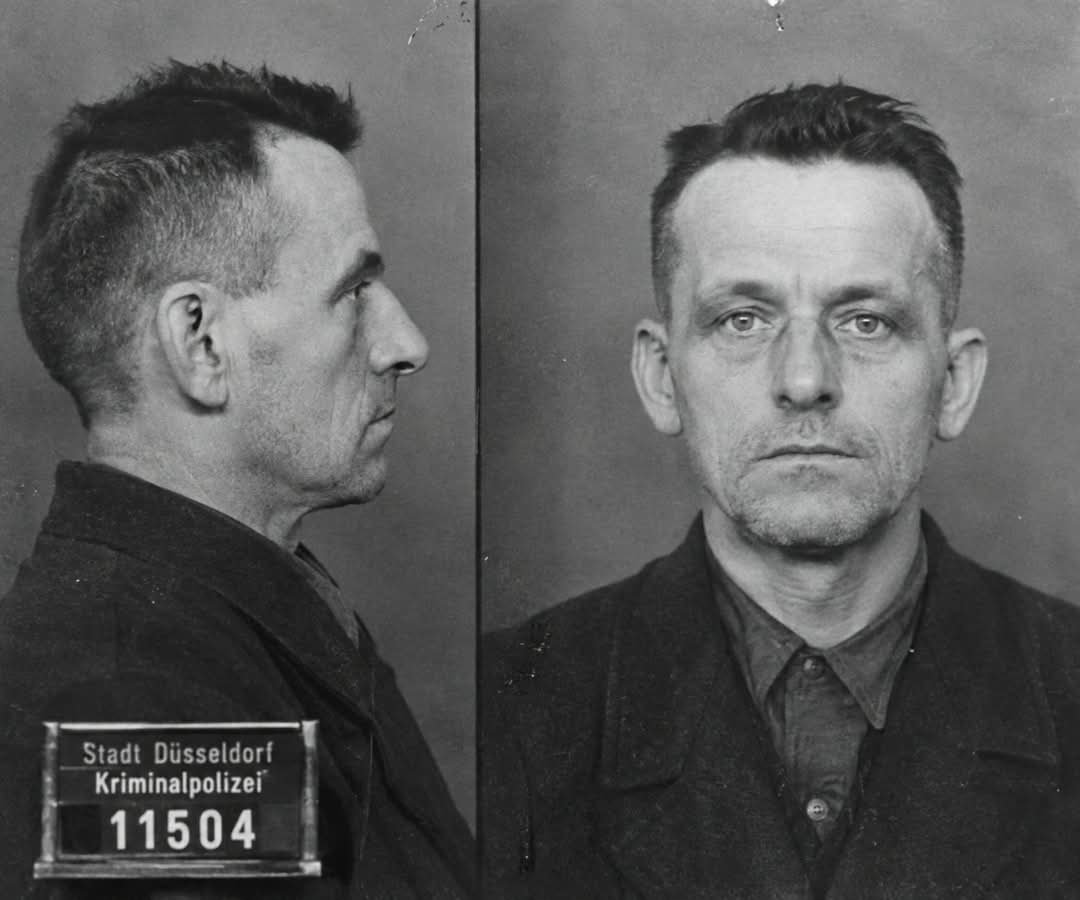
Peter Kürten Case. In the late 1920s, the German city of Düsseldorf became the center of a series of violent crimes that frightened residents and challenged the police. At the heart of the investigation was Peter Kürten, a German serial killer whose attacks on women, men, and children became some of the most notorious criminal cases in the country’s history.
Known in the press as the “Vampire of Düsseldorf,” Kürten was responsible for a series of murders and other violent attacks committed over several years. His crimes attracted widespread attention, and his eventual arrest in 1930 brought an end to a criminal investigation that had unsettled the city.
The case became significant not only because of the brutality of the crimes but also because of the extensive investigation, the public reaction, and the psychological examinations conducted after his arrest.
Early Life of Peter Kürten
Peter Kürten was born on May 26, 1883, in Mülheim am Rhein, a town near Cologne in the German Empire. He grew up in a large, impoverished family and experienced a difficult childhood.
His father was reportedly an abusive alcoholic, and accounts of Kürten’s early life describe a household marked by violence and instability. These circumstances later attracted attention during investigations into his background, although they do not, by themselves, explain his subsequent crimes.
Kürten began committing criminal offenses at a young age. He became involved in theft and other offenses and spent periods in juvenile detention and prison.
As an adult, he continued to have encounters with the criminal justice system. His offenses included theft, arson, and other acts of violence. He moved between locations and served prison sentences before settling in Düsseldorf.
Although some of his later crimes were committed years before the main investigation of 1929, authorities did not initially recognize that a single individual was responsible for the various attacks.
The Beginning of the Düsseldorf Crimes
During the late 1920s, Düsseldorf experienced a series of violent attacks that eventually became linked to Kürten.
His crimes involved different methods, including stabbing, strangulation, and attacks with blunt instruments. The victims included women and children, and some attacks occurred in public areas or near residential neighborhoods.
One of the characteristics of the case was the apparent lack of a clear pattern that could immediately identify the perpetrator. The attacks took place at different times and locations, making it difficult for investigators to establish a connection between them.
As reports of violent crimes accumulated, fear spread throughout Düsseldorf. Residents became increasingly concerned about the possibility of further attacks, while newspapers reported extensively on the investigation.
The growing public anxiety placed pressure on the police to identify and apprehend the person responsible.
The Murder of Nine-Year-Old Christine Klein
One of the crimes associated with Kürten was the murder of nine-year-old Christine Klein in Düsseldorf in August 1929.
The child was attacked and killed, and the circumstances of her death contributed to the growing alarm surrounding the series of violent crimes.
The investigation into Christine Klein’s murder formed part of the broader effort to identify the perpetrator behind the attacks. However, investigators initially lacked sufficient evidence to establish a direct connection between all the crimes.
The murder of a child intensified public concern and added to demands for the police to stop the attacks.
As the investigation continued, the authorities examined reports of assaults, suspicious incidents, and murders in an effort to identify common features.
A City Living in Fear
By 1929, the growing number of violent attacks had created widespread anxiety in Düsseldorf.
Newspapers published reports about the crimes, and residents became increasingly cautious. Women and children were particularly concerned about their safety, given the number of attacks involving female and young victims.
The police faced a difficult task because the crimes had occurred over an extended period and did not all appear identical. Investigators had to compare witness statements, physical evidence, and reports from different locations.
The case also attracted attention beyond Düsseldorf. Newspapers in other parts of Germany followed developments, and the investigation became a national story.
The press played a significant role in shaping public perceptions of the unidentified offender. The nickname “Vampire of Düsseldorf” became associated with Kürten because of the violent nature of his crimes and reports that he had attacked some victims in ways that suggested a fascination with blood.
The nickname contributed to the sensational coverage surrounding the case, although it was a newspaper label rather than a formal criminal classification.
The Investigation and Police Difficulties
The Düsseldorf police investigated numerous incidents in an effort to identify the person responsible for the killings and assaults.
The investigation required officers to examine evidence from separate crime scenes, interview witnesses, and determine which cases might be connected.
The difficulty was compounded by the fact that Kürten’s crimes had taken place over several years. Some incidents were not immediately linked to the more widely publicized murders.
Police also received numerous reports from members of the public. In a case attracting intense attention, investigators had to distinguish useful information from rumors and unreliable accusations.
As the investigation progressed, authorities increasingly recognized the possibility that several of the crimes had been committed by the same person.
Nevertheless, identifying the offender remained difficult until a personal relationship helped bring the case to a turning point.
Peter Kürten’s Arrest in 1930
The case changed in May 1930, when Kürten told his wife, Auguste, about his crimes.
According to accounts of the case, he confessed to her and indicated that he intended to surrender to the authorities. His wife subsequently contacted the police.
His arrest brought an end to the search for the person responsible for the series of attacks. Investigators then began questioning him about the crimes and comparing his statements with the evidence gathered during the investigation.
During questioning, Kürten confessed to numerous offenses, including several murders. Investigators examined these admissions alongside other evidence to determine which crimes could be attributed to him.
His statements helped connect previously separate incidents and provided information about the extent of his criminal activity.
However, the number of crimes he claimed to have committed did not automatically establish responsibility for every reported incident. Investigators and the courts had to consider the evidence associated with the individual cases.
Confessions and the Full Extent of His Crimes
After his arrest, Kürten provided detailed accounts of many of his attacks.
His confessions revealed the extent of the violence he had committed and helped investigators understand how some of the crimes were connected.
He admitted to multiple murders and other violent offenses. The crimes included attacks involving knives, blunt instruments, and strangulation.
Kürten’s statements also drew attention to earlier offenses that had not initially been connected to the Düsseldorf investigation.
The confessions shocked the public because they suggested that the offender had committed numerous attacks over a prolonged period while avoiding identification.
Investigators continued to examine the evidence, compare his accounts with known crime scenes, and determine which allegations could be substantiated.
The case became an important example of how an investigation into apparently separate crimes could reveal a larger pattern of serial violence.
Following his arrest, Kürten underwent psychiatric examinations as authorities sought to understand his behavior and determine his mental condition.
The examinations attracted considerable attention because of the nature of his crimes and the detailed confessions he provided.
Psychiatrists studied his background, personality, and descriptions of his violent acts. His case also became a subject of wider discussion among legal and medical professionals interested in criminal behavior.
However, psychological explanations did not remove his criminal responsibility. The legal proceedings focused on the crimes attributed to him and the evidence supporting the charges.
The case subsequently became part of the historical discussion surrounding the relationship between criminal violence, psychiatric examination, and the administration of justice.
The Trial of Peter Kürten
Kürten’s trial took place in Düsseldorf in April 1931.
The proceedings attracted substantial public attention because of the number and severity of the crimes associated with him. The case was widely reported in the German press, and members of the public followed the evidence presented in court.
Kürten was charged with multiple murders and attempted murders. The prosecution presented evidence concerning his attacks, his confessions, and the circumstances surrounding the crimes.
The court examined the allegations and the evidence linking him to the individual offenses.
On April 22, 1931, Kürten was convicted of nine murders and seven attempted murders.
The verdict established his criminal responsibility for the offenses covered by the convictions. Although his confessions referred to additional crimes, the convictions reflected the charges proved in court.
The judgment brought the legal proceedings to a close and marked a major development in one of Germany’s most widely publicized criminal cases of the period.
Execution at Klingelpütz Prison
Following his conviction, Peter Kürten was sentenced to death.
He was executed by guillotine at Klingelpütz Prison in Cologne on July 2, 1931.
His execution ended the criminal proceedings that had followed his arrest and trial. The case had attracted national attention for months, and the conclusion of the legal process marked the end of the immediate threat associated with the crimes.
Kürten’s death did not end public interest in the case. Reports about his offenses, confessions, and psychological examinations continued to circulate, and his name became associated with the history of German serial murder.
The Legacy of the Peter Kürten Case
The Peter Kürten case became one of the most notorious criminal investigations in Germany during the interwar period.
The crimes exposed the challenges faced by police investigating a series of violent offenses committed over an extended period. Investigators had to connect incidents that initially appeared separate, examine large amounts of information, and establish which crimes could be attributed to a single offender.
The Historabase Editorial Team is dedicated to exploring and sharing the stories that have shaped Africa and the wider world. Our work covers African history, ancient civilizations, empires, historical figures, wars, cultures, political movements, and important events from the past.
We aim to present history in a clear, engaging, and accessible way, combining historical records with careful research to help readers better understand the people, events, and civilizations that shaped our world.












One Comment