Nigeria’s history changed dramatically in 1956 when oil was discovered in commercial quantities in Oloibiri, a small community in present-day Bayelsa State. What began as decades of exploration eventually transformed the country into one of Africa’s leading oil producers. However, the discovery also introduced economic, political, and environmental challenges that continue to shape Nigeria today.
Before oil became the foundation of Nigeria’s economy, the country depended heavily on agriculture and the export of commodities such as cocoa, groundnuts, palm oil, and rubber. The discovery of commercially viable petroleum created new opportunities for government revenue and economic growth. Yet it also raised questions about resource management, regional inequality, and the long-term consequences of dependence on crude oil.
The story of Nigeria’s first oil well is therefore not simply about the discovery of a natural resource. It is about the beginning of an economic transformation that reshaped the country’s future.
Where Was Nigeria’s First Oil Well Discovered?
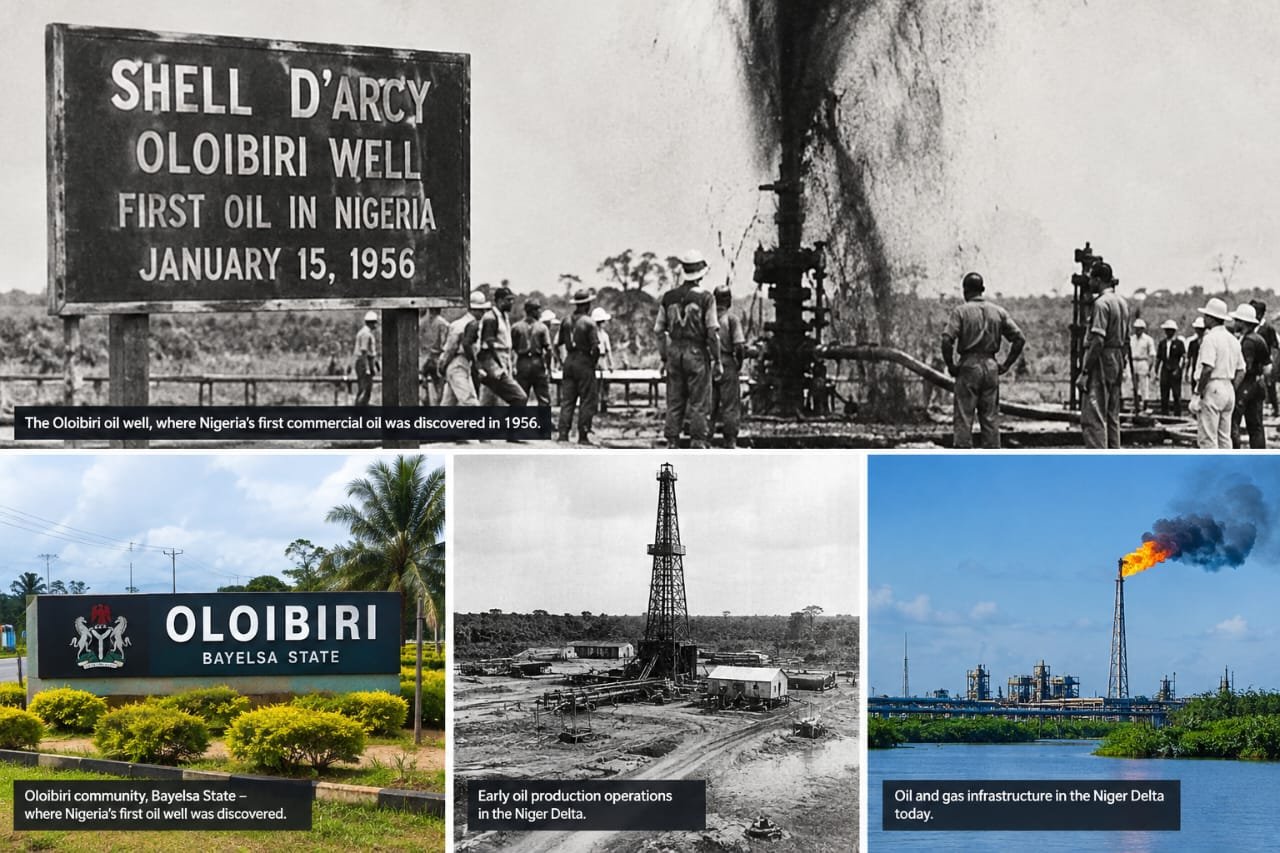
Nigeria’s first commercially successful oil well was discovered at Oloibiri, a community in the Niger Delta that is now located in Ogbia Local Government Area of Bayelsa State.
On January 15, 1956, Shell’s exploration operations recorded a commercially viable oil discovery in the area. The discovery followed years of geological surveys, drilling, and exploration conducted by petroleum companies interested in Nigeria’s oil potential.
Although petroleum exploration had taken place in the country earlier, the Oloibiri discovery marked the breakthrough that made commercial oil production possible.
Oloibiri subsequently became one of the most significant locations in Nigeria’s modern economic history. Its name is closely associated with the beginning of the country’s petroleum industry.
The Search for Oil in Colonial Nigeria
The discovery at Oloibiri did not happen overnight.
Oil exploration in Nigeria began during the colonial period, when the British administration introduced legislation that allowed exploration rights to be granted to petroleum companies.
In 1937, Shell received an exploration licence covering a large area of Nigeria. Its exploration activities were interrupted by the Second World War, which affected industrial operations and international economic activity.
After the war, exploration resumed. Geologists and engineers examined different parts of the country, searching for geological formations that could contain commercially recoverable petroleum.
The Niger Delta attracted particular attention because of its geological characteristics. Its sedimentary formations offered promising conditions for oil accumulation.
After years of unsuccessful drilling and substantial investment, the breakthrough finally came at Oloibiri in 1956.
The discovery demonstrated that Nigeria possessed commercially significant petroleum reserves and opened the door to a new phase of industrial development.
When Did Nigeria Begin Producing Oil?
Following the Oloibiri discovery, Nigeria began exporting crude oil in 1958.
Initial production was relatively modest compared with the enormous volumes the country would eventually produce. Nevertheless, the start of commercial exports established Nigeria as an emerging oil-producing country.
The development of oil infrastructure accelerated over the following years. Pipelines, terminals, processing facilities, and other installations were constructed to support the growing petroleum industry.
At the time, Nigeria was approaching independence from Britain, which it achieved on October 1, 1960.
Oil therefore became commercially important during a critical period in the country’s political development. The new Nigerian government inherited an industry with considerable potential to generate revenue, attract foreign investment, and support national development.
How Oil Changed Nigeria’s Economy
Before petroleum became dominant, agriculture was central to Nigeria’s economy.
Different regions developed strong agricultural industries. Cocoa was especially important in the west, groundnuts were a major export from the north, and palm produce was significant in the east and parts of the south.
Oil gradually changed this economic structure.
As petroleum production increased, crude oil exports became a major source of foreign exchange and government revenue. Oil earnings helped finance public spending, infrastructure projects, and the expansion of government institutions.
Nigeria’s growing petroleum industry also attracted international companies, technical expertise, and investment.
However, the transition created a serious economic challenge: dependence on a single major export.
As oil became increasingly important, agriculture received less attention in national economic planning. This shift contributed to the weakening of some agricultural export industries and made government revenue more vulnerable to changes in global oil prices.
The result was an economy with enormous petroleum wealth but persistent difficulties in diversification, industrial development, and employment creation.
The Niger Delta and the Cost of Oil Production
Although oil brought substantial revenue to Nigeria, communities in the Niger Delta experienced many of its most immediate environmental and social consequences.
Oil production required wells, pipelines, flow stations, roads, and other infrastructure. When poorly maintained equipment, operational failures, and other incidents resulted in oil spills, farmland, waterways, and fishing grounds could be affected.
For communities that depended on farming and fishing, environmental damage threatened livelihoods and traditional ways of life.
Over the decades, concerns about pollution, compensation, resource ownership, and the distribution of oil revenue contributed to growing tensions between local communities, petroleum companies, and government authorities.
The Niger Delta became the centre of national debates about environmental protection, development, and the responsibilities of companies operating in resource-producing areas.
These problems also highlighted an important contradiction in Nigeria’s oil story: communities living closest to the resource have not always experienced the same level of prosperity as the country has gained from petroleum exports.
Oil and Nigeria’s Political History
The growing importance of petroleum also changed Nigerian politics.
As oil revenues increased, control over the distribution of national income became increasingly important to federal and state governments.
Following the Nigerian Civil War, which ended in 1970, rising oil earnings helped strengthen the federal government’s financial position. The oil boom of the 1970s brought a dramatic increase in petroleum revenue and expanded public expenditure.
However, the concentration of economic power around oil also intensified debates about federalism, revenue allocation, regional development, and resource control.
Nigeria’s political institutions increasingly depended on decisions about how petroleum revenue should be collected and distributed.
The industry also exposed the country to economic instability. When international oil prices fell, government revenue could decline sharply, creating pressure on public finances and the wider economy.
Oil became both a source of national wealth and a factor in the country’s continuing political and economic challenges.
What Happened to Oloibiri After the Discovery?
Oloibiri holds an important place in Nigeria’s petroleum history, but its experience has also raised questions about the distribution of oil wealth.
The community became famous as the location of Nigeria’s first commercial oil discovery. Yet it did not develop into the major industrial centre that some might expect from a place associated with such a historic event.
Over time, the original oilfield declined in production, reflecting the natural depletion of petroleum reserves and the changing economics of oil extraction.
The community’s experience became part of a wider national discussion about whether oil-producing areas had received sufficient infrastructure, environmental restoration, and economic opportunities in return for their contribution to the national economy.
Oloibiri’s legacy therefore includes both the promise of Nigeria’s petroleum wealth and the challenges of ensuring that resource-producing communities benefit meaningfully from it.
The site remains an important symbol of the country’s oil history and the need to connect natural-resource development with lasting local progress.
Does Nigeria Still Depend on Oil Today?
Petroleum remains an important part of Nigeria’s economy, particularly in export earnings and government revenue.
However, the country faces growing pressure to diversify its economy, improve domestic refining capacity, expand agriculture, strengthen manufacturing, and develop other productive industries.
Oil production has also faced challenges, including theft, pipeline vandalism, underinvestment, operational difficulties, and fluctuations in international demand and prices.
At the same time, the global transition toward lower-carbon energy sources has created uncertainty about the long-term future of petroleum-dependent economies.
For Nigeria, these developments make economic diversification increasingly important.
The country must find ways to use its natural resources to support sustainable development without allowing dependence on crude oil to limit opportunities in other sectors.
Conclusion: The Discovery That Changed Nigeria Forever
The discovery of commercially viable oil at Oloibiri in 1956 marked a turning point in Nigeria’s history.
It transformed the country’s economic prospects, established petroleum as a major source of government revenue, and influenced political decisions for generations.
Yet the discovery also exposed serious challenges involving environmental protection, economic dependence, regional inequality, and the management of national resources.
Today, Oloibiri represents more than the birthplace of Nigeria’s oil industry. It serves as a reminder that natural wealth alone does not guarantee prosperity.
The lasting value of Nigeria’s oil discovery will ultimately depend on how effectively the country converts its resources into sustainable economic growth, better public services, environmental protection, and improved living standards for its people.
The Historabase Editorial Team is dedicated to exploring and sharing the stories that have shaped Africa and the wider world. Our work covers African history, ancient civilizations, empires, historical figures, wars, cultures, political movements, and important events from the past.
We aim to present history in a clear, engaging, and accessible way, combining historical records with careful research to help readers better understand the people, events, and civilizations that shaped our world.











One Comment