On November 24, 1971, a man using the name Dan Cooper boarded a Northwest Orient Airlines flight in the United States, bought a one way ticket, and disappeared into history.
He would later become known around the world as D. B. Cooper, although that name was actually the result of a media error.
What made his story extraordinary was not simply that he hijacked an aircraft. After receiving a ransom of $200,000, Cooper parachuted from the plane into the darkness over the Pacific Northwest, and was never conclusively found.
More than five decades later, his identity and fate remain among America’s most famous unsolved mysteries.
The Man Who Called Himself Dan Cooper
Very little is known with certainty about the man who became D. B. Cooper.
On the afternoon of November 24, he walked into the Northwest Orient Airlines ticket counter at Portland International Airport in Oregon. He purchased a one-way ticket to Seattle, Washington, using cash.
The name on the ticket was Dan Cooper.
He appeared to be an ordinary businessman. Witnesses described him as a man in his mid-40s, wearing a dark suit, white shirt and black tie.
Nothing about him initially suggested that he was about to commit one of the most famous crimes in American history.
The Hijacking Begins
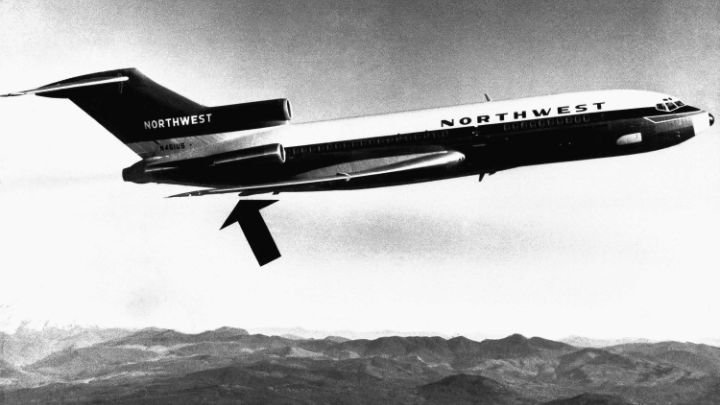
Cooper boarded Northwest Orient Flight 305, a Boeing 727 carrying 36 passengers and a crew of six.
Shortly after takeoff from Portland, he handed a note to flight attendant Florence Schaffner.
At first, Schaffner thought he was simply giving her his telephone number. Cooper quietly indicated that she should read the note.
The message revealed his true intentions.
He claimed to have a bomb and demanded $200,000 in $20 bills, four parachutes and a fuel truck standing by in Seattle.
Schaffner informed the flight crew, and the pilots contacted authorities.
The passengers, however, were not initially told that the aircraft had been hijacked.
The Ransom
The aircraft landed at Seattle-Tacoma International Airport, where authorities prepared Cooper’s demands.
The ransom consisted of $200,000 in $20 bills. The serial numbers had been recorded by investigators in an attempt to make the money traceable.
Four parachutes were also provided.
Once the demands had been met, Cooper released all 36 passengers.
But he was not finished.
He instructed the crew to refuel the aircraft and prepare for another flight.
His plan was about to become even more extraordinary.
The Second Flight
After the passengers left, Flight 305 took off again with Cooper and the remaining crew members aboard.
He ordered the pilots to fly toward Mexico City at a relatively low altitude and reduced airspeed.
However, the aircraft did not have enough fuel to reach Mexico City without stopping.
A compromise was reached.
The plane would first travel to Reno, Nevada, where it could refuel.
Cooper remained calm throughout the flight.
He also ordered the aircraft to maintain conditions that would make his escape possible.
The Boeing 727 had a distinctive feature that would become central to the case: a rear staircase that could be lowered while the aircraft was in flight.
The Jump
At approximately 8:00 p.m., while the aircraft was somewhere over southwestern Washington State, Cooper prepared to leave.
The crew noticed that the rear staircase had been lowered.
Cooper had attached the ransom money to himself and was wearing a parachute.
Then he disappeared into the night.
The pilots continued flying toward Reno.
They did not immediately know exactly when Cooper had jumped.
When the aircraft landed in Nevada, law enforcement officers surrounded it.
But Cooper was gone.
So was the ransom.
The Search for D. B. Cooper
One of the largest manhunts in American history followed.
The FBI, military personnel, state authorities and local law enforcement searched forests, rivers and rugged terrain across the Pacific Northwest.
Investigators believed Cooper had jumped somewhere near the Columbia River, but the exact location was uncertain.
The weather that night was poor.
It was dark, cold and rainy, and the terrain below consisted largely of dense forests and difficult mountainous country.
If Cooper survived the jump, finding him would be extremely difficult.
If he died, his body could have remained hidden for decades.
No confirmed trace of Cooper was discovered.
The $200,000 Mystery
The ransom money provided investigators with their most promising potential clue.
In 1980, nearly nine years after the hijacking, an eight-year-old boy named Brian Ingram discovered three bundles of deteriorating $20 bills while playing along the Columbia River near Vancouver, Washington.
The bills totaled $5,800.
Their serial numbers matched money given to Cooper.
It was the first and remains the most significant physical evidence discovered from the ransom.
But it created another mystery.
How had the money reached that location?
Did Cooper bury or lose it?
Did the river carry it there?
And what happened to the remaining $194,200?
No definitive answer has ever been established.
Was Cooper Really D. B. Cooper?
Interestingly, the famous name D. B. Cooper was not the name used by the hijacker.
He purchased his ticket under the name Dan Cooper.
During the early reporting of the case, a journalist apparently received incorrect information and referred to the hijacker as “D. B. Cooper.”
The name became widely adopted by the media and the public.
Investigators continued to refer to the suspect as Cooper, but the mistaken name became permanently associated with the mystery.
The Investigation
The FBI investigated thousands of leads.
Hundreds of people were considered possible suspects.
Some individuals even confessed to being Cooper, while others were identified by investigators as potential suspects.
Photographs, fingerprints, witness descriptions and other evidence were examined.
The FBI eventually developed a composite sketch of the suspect.
Despite decades of investigation, however, authorities never established Cooper’s true identity.
His fingerprints were found on the aircraft, and witnesses provided descriptions of his appearance, but these clues were not enough to identify him conclusively.
Did Cooper Survive?
This remains the biggest question.
There are two major possibilities.
Cooper Died During the Jump
The FBI has long considered it possible that Cooper did not survive.
He jumped into unfamiliar terrain at night, wearing clothing that was not ideal for the conditions. The parachute equipment and weather also created serious risks.
If he landed in the wilderness and died, his remains might never have been discovered.
Cooper Survived
The alternative is that Cooper successfully landed, escaped the area and lived under another identity.
Supporters of this theory point to the absence of a body and the fact that much of the ransom was never recovered.
Some people have claimed that they were Cooper or identified relatives and acquaintances as the hijacker, but none of these claims has been conclusively proven.
Why the Case Became Legendary
The Cooper case captured the public imagination because it contained almost everything associated with a great mystery.
There was a mysterious stranger.
There was a hijacked aircraft.
There was a large ransom.
There was a parachute escape.
And then there was disappearance.
Unlike many criminals, Cooper seemed to vanish completely.
He left behind no confirmed identity, no known destination and no clear explanation of what happened after his jump.
The mystery became a subject of books, documentaries, television programs and countless investigations.
The FBI Ends Its Active Investigation
After spending decades investigating the case, the FBI officially suspended its active investigation in 2016.
The agency stated that none of the evidence available had conclusively identified Cooper.
Although the FBI stopped actively pursuing new leads, the case itself remains unsolved.
The evidence collected over the years has continued to attract independent researchers and amateur investigators.
The hijacking also had consequences beyond the mystery surrounding Cooper.
In the years that followed, security measures at airports and aboard commercial aircraft became significantly stricter.
One specific development was the installation of devices designed to prevent the rear staircase of Boeing 727 aircraft from being opened during flight.
The device became informally known as the “Cooper vane.”
The case therefore influenced aviation security even though investigators never determined exactly what happened to the hijacker.
The Mystery Lives On
More than half a century later, D. B. Cooper remains one of the most famous unidentified figures in American criminal history.
The facts are remarkably simple:
A man calling himself Dan Cooper hijacked a Boeing 727 in 1971.
He demanded $200,000 and parachutes.
He released the passengers.
He then jumped from the aircraft somewhere over the Pacific Northwest.
And he was never conclusively found.
The discovery of $5,800 of the ransom in 1980 proved that at least some of the money reached the ground, but it did not solve the mystery.
Whether Cooper died in the wilderness or survived and quietly disappeared into ordinary life remains unknown.
Conclusion
The story of D. B. Cooper has endured because it offers something rare in modern criminal history: a case in which the central mystery remains unanswered.
There is no confirmed photograph of him after the hijacking, no identified grave and no definitive evidence explaining his fate.
The man who boarded Flight 305 on November 24, 1971, may have died during his daring escape, or he may have successfully disappeared.
The Historabase Editorial Team is dedicated to exploring and sharing the stories that have shaped Africa and the wider world. Our work covers African history, ancient civilizations, empires, historical figures, wars, cultures, political movements, and important events from the past.
We aim to present history in a clear, engaging, and accessible way, combining historical records with careful research to help readers better understand the people, events, and civilizations that shaped our world.