Islam is one of the world’s major religions, followed by more than a billion people across every continent. Its origins can be traced to seventh-century Arabia, where a merchant from Mecca named Muhammad began receiving revelations that would eventually form the Quran.
Within just a few decades, the religious movement that began in Mecca had spread across much of the Arabian Peninsula and, under the early caliphates, expanded into parts of Africa, Asia and Europe.
But how exactly did Islam begin? What was Arabia like before Islam, and how did a small religious community develop into a civilization that would profoundly influence world history?
Arabia Before Islam
To understand the emergence of Islam, it is important to understand the society in which it developed.
In the early seventh century, the Arabian Peninsula was home to diverse tribes and communities. Many people lived in tribal societies where family and clan relationships played an important role in political and social life.
Religious beliefs also varied. Many Arabs practiced forms of polytheism and worshipped different deities. Mecca was an important religious and commercial center, and the Kaaba was already regarded as a sacred sanctuary.
Judaism and Christianity were also present in parts of Arabia, while some individuals followed monotheistic beliefs outside established religious communities.
Arabian society was not simply defined by religion. Trade, poetry, tribal alliances, warfare and hospitality were important elements of life. Mecca’s position along regional trade routes also contributed to its importance.
It was into this environment that Muhammad was born.
The Early Life of Muhammad
Muhammad was born in Mecca, traditionally dated to around 570 CE. He belonged to the Quraysh tribe, one of the influential tribal groups in the city.
According to Islamic tradition, Muhammad lost both parents at an early age and was raised first by his grandfather and later by his uncle, Abu Talib.
As an adult, Muhammad became known as a merchant. Islamic historical sources describe him as being respected for his honesty and reliability.
He eventually married Khadija, a wealthy merchant and widow who had employed him. Their marriage became an important part of Muhammad’s early life.
By his forties, Muhammad had developed a practice of withdrawing from the busy life of Mecca to spend time in reflection and prayer.
This period would lead to an event that Muslims regard as the beginning of Islam.
The First Revelation in 610 CE
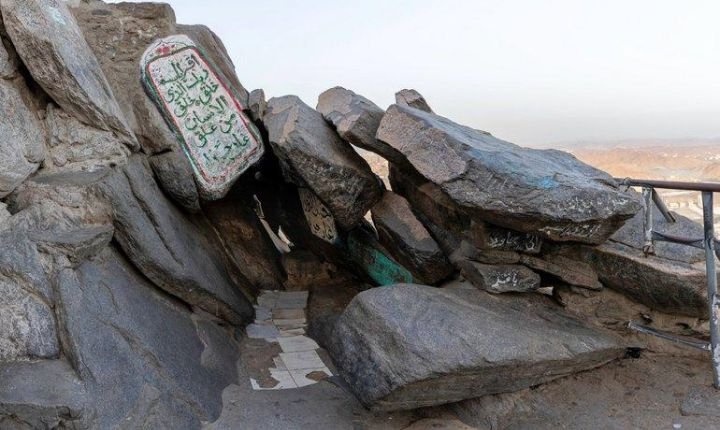
Around the year 610 CE, Muhammad was in a cave known as Hira, near Mecca, when he experienced what Muslims believe was his first revelation from God.
According to Islamic tradition, the angel Gabriel appeared to Muhammad and commanded him to recite.
Muhammad initially returned home deeply shaken by the experience. Khadija supported him and became the first person traditionally regarded as accepting his message.
The revelations continued over the following years.
Muslims believe these revelations came from Allah and were ultimately collected as the Quran, Islam’s sacred scripture.
The central message was uncompromising monotheism: there is only one God, and human beings should worship Him alone.
Muhammad also preached moral responsibility, charity, justice, accountability before God and concern for the poor and vulnerable.
The Message Faces Opposition
Muhammad’s preaching challenged important aspects of Meccan society.
His message rejected the worship of multiple gods and criticized social injustice and the exploitation of vulnerable people. It also challenged the religious practices associated with the Kaaba.
As Muhammad’s following grew, opposition from influential members of Meccan society increased.
Early Muslims faced social pressure and persecution. Some eventually migrated to the Christian kingdom of Aksum in East Africa, traditionally identified with modern Ethiopia and Eritrea, seeking protection from persecution.
Muhammad nevertheless continued preaching in Mecca.
For approximately thirteen years, his followers remained a relatively small community.
Then came a turning point.
The Hijra: Migration to Medina
In 622 CE, Muhammad and his followers migrated from Mecca to Yathrib, a settlement later known as Medina.
This migration is called the Hijra and became one of the most important events in Islamic history.
The Islamic calendar begins with the Hijra.
In Medina, Muhammad’s role expanded beyond that of a religious preacher. He became the leader of a growing community and was involved in political, social and military affairs.
Different groups in Medina entered agreements with Muhammad’s community, and the city became the center of the emerging Muslim polity.
Islam was no longer simply a small religious movement in Mecca. It had developed into an organized community.
The Early Battles
Relations between the Muslims and Meccans eventually resulted in armed conflict.
One of the most famous early confrontations was the Battle of Badr in 624 CE. Although the Muslim force was smaller, it defeated a larger Meccan force.
The victory strengthened the position of Muhammad and his followers.
In 625, the two sides fought again at the Battle of Uhud. The Muslims suffered a serious setback, demonstrating that the new community was not invincible.
Another major confrontation occurred during the Battle of the Trench in 627, when Medina was threatened by a large coalition.
The Muslim community survived these conflicts, and Muhammad’s political influence continued to grow.
The Treaty of Hudaybiyyah
In 628 CE, Muhammad and his followers attempted to make a pilgrimage to Mecca.
Rather than fighting, negotiations produced the Treaty of Hudaybiyyah, an agreement between the Muslims and the Quraysh.
Although some Muslims initially regarded aspects of the treaty as unfavorable, it created a period of relative peace.
During this period, Muhammad’s message reached a wider audience, and the Muslim community continued to expand.
The Conquest of Mecca
Relations between Muhammad and the Quraysh eventually deteriorated.
In 630 CE, Muhammad entered Mecca with a large Muslim force. The city surrendered with limited fighting.
The event became a major turning point.
Muhammad returned to the city from which he had been opposed years earlier. The Kaaba was rededicated to the worship of one God, and the religious movement that had begun in Mecca now held control over the city.
Other Arabian tribes increasingly entered alliances with Muhammad or accepted Islam.
By the final years of Muhammad’s life, much of the Arabian Peninsula had come under the influence of the Muslim community.
Muhammad’s Final Years and Death
In 632 CE, Muhammad performed what became known as the Farewell Pilgrimage.
During this period, Islamic tradition records important teachings concerning religious obligations, morality, social responsibility and the treatment of others.
Later that year, Muhammad became ill and died in Medina at approximately the age of 62 or 63.
His death created a major question for the Muslim community: who would lead the Muslims after him?
Muhammad had been the religious and political leader of the community, but he had not left behind a universally accepted political succession arrangement.
This issue would eventually contribute to one of the most important divisions in Islamic history.
Abu Bakr and the First Caliphate
After Muhammad’s death, Abu Bakr, one of his close companions and father-in-law, became the first caliph.
A series of conflicts known as the Ridda Wars followed. Some Arabian tribes rejected the authority of Medina or stopped paying required obligations after Muhammad’s death.
Abu Bakr’s forces defeated these movements and helped reunify much of Arabia under the authority of the emerging caliphate.
After Abu Bakr’s death in 634, Umar ibn al-Khattab became the second caliph.
Under Umar, the Muslim state expanded dramatically.
Muslim armies conquered territories previously controlled by the Byzantine and Sasanian empires, including Syria, Egypt and parts of Persia.
The Expansion of Islam
Islam’s expansion was one of the most significant developments of the seventh and eighth centuries.
Under the early caliphates, Muslim rule spread beyond Arabia into the Middle East, North Africa, Central Asia and parts of southern Europe.
Egypt became an important center of Islamic civilization.
North Africa gradually became predominantly Muslim over the following centuries, although the process was neither immediate nor uniform.
Islam also spread through trade, scholarship, migration and political expansion.
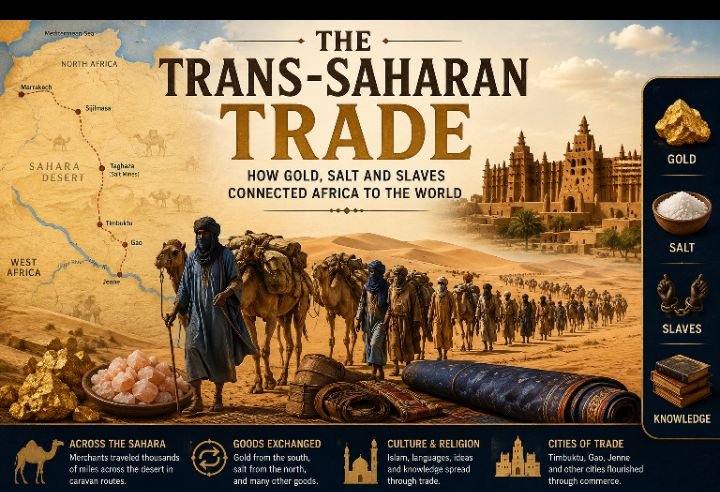
In West Africa, Muslim merchants and scholars played important roles in the spread of Islam across the Sahara. Over subsequent centuries, rulers and communities in kingdoms such as Ghana, Mali, Songhai and Kanem-Bornu adopted Islam to varying degrees.
The religion therefore spread through multiple mechanisms rather than through military conquest alone.
The Sunni-Shia Divide
The question of leadership after Muhammad eventually produced a major division within Islam.
Those who became known as Sunni Muslims generally accepted the legitimacy of the early caliphs beginning with Abu Bakr.
Those who became known as Shia Muslims believed that Ali ibn Abi Talib, Muhammad’s cousin and son-in-law, and his descendants had a special claim to leadership of the Muslim community.
The division developed over time and became deeply connected to political conflicts.
One of the most important events was the Battle of Karbala in 680 CE, where Husayn ibn Ali, the grandson of Muhammad, was killed along with many of his supporters.
Karbala became particularly central to Shia religious identity and remains commemorated to this day.
The Umayyad and Abbasid Eras
In 661 CE, the Umayyad dynasty established its capital in Damascus.
Under Umayyad rule, the Islamic state expanded even further. Muslim armies reached North Africa and crossed into the Iberian Peninsula in 711 CE.
At its greatest extent, the Umayyad Caliphate stretched across enormous territories.
In 750 CE, the Abbasids overthrew the Umayyads in most of the Islamic world and established a new caliphate.
The Abbasid period became famous for scholarship, science, medicine, mathematics, philosophy and literature.
Baghdad became one of the world’s great intellectual centers.
Muslim scholars translated and developed knowledge from Greek, Persian, Indian and other intellectual traditions. Their work later contributed to the transmission of important scientific and philosophical ideas to Europe.
Islam in Africa
Africa played an important role in Islamic history from the very beginning.
The earliest Muslims who fled persecution in Mecca crossed the Red Sea and sought refuge in the Christian kingdom of Aksum.
Later, Egypt became one of the earliest regions outside Arabia to come under Muslim rule.
Islam gradually spread westward across North Africa and eventually southward through the Sahara.
By the medieval period, Muslim scholars and merchants had established connections with powerful West African states.
The Mali Empire became particularly famous under Mansa Musa, whose pilgrimage to Mecca in 1324 demonstrated the wealth and international connections of West African Muslim civilization.
Cities such as Timbuktu became important centers of Islamic scholarship.
From Arabia to a Global Religion
Islam did not remain confined to the Middle East or Africa.
Over the centuries, Muslim communities emerged throughout Central and South Asia, Southeast Asia, China and parts of Europe.
Trade was especially important in places such as East Africa and Southeast Asia. Muslim merchants established communities along commercial networks, and Islam gradually became established in many coastal societies.
By the modern era, Islam had become a global religion with followers from countless ethnic, linguistic and cultural backgrounds.
The Historical Legacy of Islam
The emergence of Islam transformed the history of Arabia and eventually reshaped much of the wider world.
It created a new religious community that developed into powerful states and civilizations. Muslim societies produced influential scholars in mathematics, astronomy, medicine, geography, philosophy, architecture and literature.
Islam also contributed to the development of major cities and intellectual centers stretching from West Africa to the Middle East and Asia.
At the same time, Islamic history contains political struggles, wars, dynastic conflicts and religious disagreements, just like the histories of other major civilizations.
Understanding Islam’s history therefore requires looking beyond simple narratives of conquest or religion. Its development was shaped by faith, politics, trade, culture, scholarship and interactions between many different peoples.
Conclusion
Islam emerged in seventh-century Arabia through the preaching of Muhammad, beginning with the revelations he received around 610 CE.
The movement grew from a small community in Mecca into an organized society in Medina. After Muhammad’s death in 632 CE, the early caliphates expanded Muslim political rule across large parts of the Middle East, North Africa and beyond.
Over the centuries, Islam spread through conquest, trade, migration, scholarship and the conversion of rulers and communities.
Today, Islam is a global faith whose history stretches across more than fourteen centuries.
Its origins in the Arabian Peninsula were only the beginning of a historical transformation that would influence Africa, Asia, Europe and eventually virtually every part of the world.
The Historabase Editorial Team is dedicated to exploring and sharing the stories that have shaped Africa and the wider world. Our work covers African history, ancient civilizations, empires, historical figures, wars, cultures, political movements, and important events from the past.
We aim to present history in a clear, engaging, and accessible way, combining historical records with careful research to help readers better understand the people, events, and civilizations that shaped our world.








2 Comments