Every day, Nigerians handle the ₦50 note without giving much thought to the faces and symbols printed on it. It may pass from a market trader to a customer, from a bus conductor to a passenger, or from one bank account to another.
But hidden in that small piece of currency is a message about Nigeria’s diversity, identity and national unity.
The ₦50 note was introduced in October 1991, at a time when Nigeria was expanding its currency system and introducing a new denomination. It was later redesigned, including the version issued in 2007, and subsequently moved to polymer.
Unlike denominations that feature the portraits of individual national heroes, the ₦50 note was designed around ordinary Nigerians and the country’s cultural diversity.
Four Nigerians, One Country
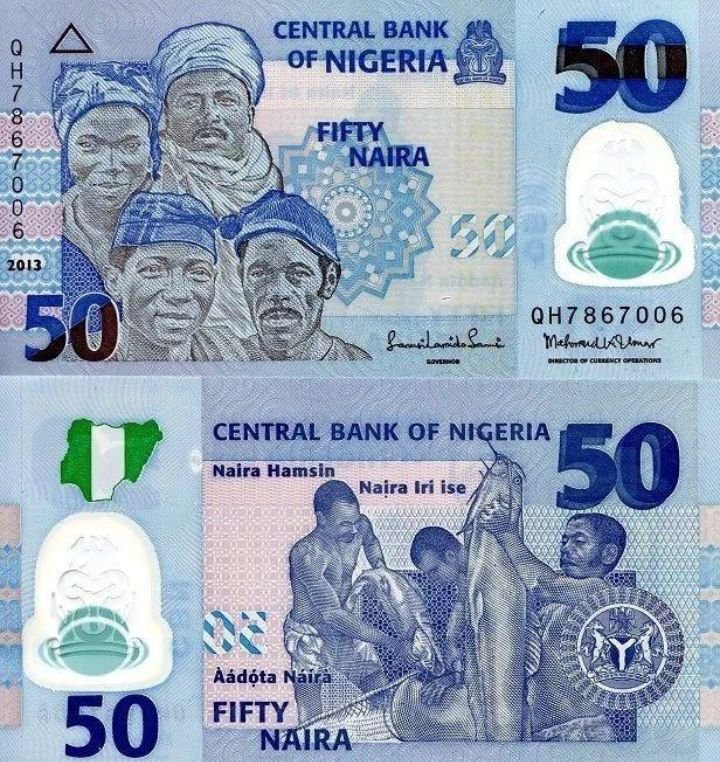
The most striking feature on the front of the ₦50 note is a group of four Nigerians superimposed over a map of Nigeria.
According to the Central Bank of Nigeria, the design contains the hand-engraved portraits of three men and a woman.
The three male figures are traditionally understood as representing Nigeria’s three largest ethnic groupings: Hausa, Igbo and Yoruba. The female figure represents the wider Nigerian population rather than being presented as a portrait of a famous individual.
The clothing and appearance of the figures were deliberately used to communicate cultural identity. Academic research on Nigerian banknotes describes the images as representing Hausa, Igbo and Yoruba cultural identities, while the fourth figure reinforces the broader idea of Nigerians sharing a common national identity.
It is important to understand that Nigeria is far more diverse than these three groups. The country has more than 250 ethnic groups, with many other communities spread across the federation.
Therefore, the ₦50 note should not be interpreted as saying that Nigeria consists only of three ethnicities. Rather, the design reflects a long-standing national representation of three of the country’s largest population groups while placing them within the map of the entire country.
Why Hausa, Igbo and Yoruba?
The decision to portray these groups was closely connected to Nigeria’s complex political and cultural history.
The Hausa are historically dominant across much of northern Nigeria, the Yoruba are concentrated largely in the southwest, while the Igbo are predominantly associated with southeastern Nigeria.
Each developed its own languages, traditions, political institutions, clothing styles and cultural systems long before the creation of modern Nigeria.
Yet colonial rule brought many of these different societies under one political entity.
By independence in 1960, Nigeria had inherited a country containing hundreds of ethnic and linguistic communities. Managing that diversity became one of the central challenges of the Nigerian state.
The ₦50 note therefore became more than a medium of exchange.
It became a small representation of the idea that people with different histories and cultures could belong to one nation.
The Map of Nigeria Is Important
Look closely at the design and you will notice that the people are placed over a map of Nigeria.
That detail is significant.
The designers did not simply place three cultural figures side by side. They placed them within the outline of the country.
The message is essentially one of unity within diversity.
The cultural identities remain visible, but they exist inside a larger Nigerian identity.
This idea is consistent with the wider philosophy behind Nigerian banknote design. The Central Bank says Nigerian currency incorporates images representing culture, agricultural production, mineral resources and national heroes and heroines.
In other words, Nigerian money was designed to tell stories about the country, not merely to display its monetary value.
The Woman on the ₦50 Note
One of the most interesting details is the presence of the woman.
She is sometimes overlooked because the three male figures tend to attract most of the attention.
Unlike famous personalities such as Nnamdi Azikiwe, Obafemi Awolowo or Ahmadu Bello, the woman on the ₦50 note is not presented as a named historical hero.
Her inclusion gives the composition another dimension: the note is not exclusively about political leaders or prominent men. It presents ordinary Nigerian people as part of the country’s national identity.
Interestingly, historical accounts of the note have also linked the female image to Maryam Babangida, who was Nigeria’s First Lady when the ₦50 note was introduced in 1991. However, the Central Bank’s official currency description identifies the front simply as portraits of four Nigerians rather than naming the individuals.
That distinction is important when discussing the note’s history.
What Is on the Back?
The story does not end on the front.
The reverse side of the ₦50 note depicts fishermen displaying a large catch. The Central Bank identifies the image as a representation of local fishermen and, in its currency materials, links such imagery to Nigeria’s agricultural and economic activities.
This was another deliberate choice.
While the front focuses on people, culture and national identity, the reverse draws attention to work, food production and economic activity.
The fisherman therefore represents another important aspect of Nigeria: a country whose people have historically depended on farming, fishing and other forms of productive labour.
Even the Cowrie Shell Has a Story
There is another historical detail hidden on the note.
The ₦50 design incorporates cowrie-shell imagery.
Before the modern naira existed, various objects—including cowries, manillas, beads and other commodities—were used as mediums of exchange in different parts of what became Nigeria.
The Central Bank notes that cowrie shells were once used as a medium of exchange in the country.
So even this small decorative element connects modern Nigerian currency with the much older history of trade and exchange in West Africa.
From Paper to Polymer
The ₦50 note has also gone through several stages.
It was first introduced in 1991 as a paper banknote. The note was redesigned in 2007, and in 2009 the ₦50 was converted to polymer as part of a move involving the lower denominations.
The polymer version became the familiar ₦50 note that millions of Nigerians have handled over the years.
Despite these changes, the central cultural concept of the design remained.
More Than ₦50
Today, the ₦50 note may seem like an ordinary denomination with modest purchasing power.
Historically, however, its significance goes beyond its monetary value.
It carries a visual reminder of one of Nigeria’s biggest realities: diversity.
The Hausa, Igbo and Yoruba figures represent major cultural identities, while the additional female figure and the map of Nigeria broaden the image beyond individual ethnic identities.
The note essentially turns an everyday financial object into a miniature history lesson.
Every time it changes hands, it carries an image of Nigerians from different cultural backgrounds sharing the same national space.
And perhaps that is the most interesting thing about the ₦50 note.
The Historabase Editorial Team is dedicated to exploring and sharing the stories that have shaped Africa and the wider world. Our work covers African history, ancient civilizations, empires, historical figures, wars, cultures, political movements, and important events from the past.
We aim to present history in a clear, engaging, and accessible way, combining historical records with careful research to help readers better understand the people, events, and civilizations that shaped our world.







One Comment