On May 29, 1453, one of the most significant events in world history took place. Constantinople, the capital of the Byzantine Empire and one of the greatest cities of the medieval world, fell to the Ottoman Empire under the leadership of Sultan Mehmed II.
The fall of Constantinople did more than bring the Byzantine Empire to an end. It strengthened the Ottoman Empire, transformed trade and politics between Europe and Asia, and helped create conditions that contributed to the European Age of Exploration.
The City at the Center of History
Constantinople was founded as the new capital of the Roman Empire by Emperor Constantine the Great in AD 330. Strategically located between Europe and Asia, the city controlled important trade routes connecting the Mediterranean world with the Black Sea and the East.
After the Western Roman Empire collapsed in 476, Constantinople remained the capital of the Eastern Roman Empire, commonly known today as the Byzantine Empire.
For centuries, the city survived wars, invasions and political crises. Its enormous defensive walls made it one of the most difficult cities in the world to conquer.
By the 15th century, however, the Byzantine Empire had been reduced to little more than Constantinople and a few surrounding territories.
The Rise of the Ottoman Empire
While the Byzantine Empire weakened, the Ottoman Empire was rapidly expanding.
The Ottomans had captured large parts of southeastern Europe and Anatolia, gradually surrounding Constantinople. Sultan Mehmed II, who became ruler in 1451, was determined to capture the city.
Mehmed was only 21 years old when he launched his campaign, but he possessed a powerful army and access to advanced military technology, including large cannons capable of attacking Constantinople’s famous walls.
He also constructed Rumeli Hisarı, a fortress on the European side of the Bosporus, helping the Ottomans control movement through the strategic waterway.
The Siege of Constantinople
The siege began on April 6, 1453.
Constantinople was defended by Emperor Constantine XI Palaiologos and a relatively small force of Byzantine and allied soldiers. The defenders relied heavily on the city’s massive walls, which had protected Constantinople for centuries.
The Ottoman army, however, was far larger.
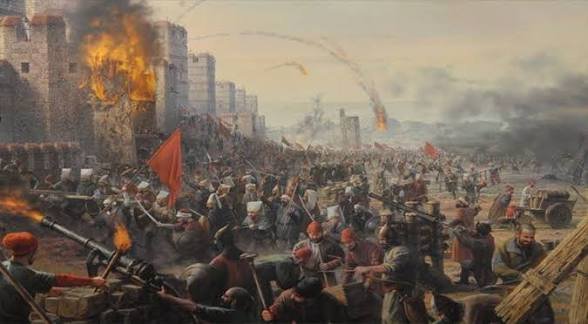
One of the most important weapons used during the siege was a huge cannon traditionally associated with the Hungarian engineer Orban. Ottoman artillery repeatedly bombarded the city’s defensive walls.
The Byzantines also used chains across the Golden Horn to prevent Ottoman ships from entering the harbor.
Mehmed responded with an extraordinary strategy. Ottoman forces transported ships over land and into the Golden Horn, bypassing the defensive chain. This placed additional pressure on the city’s defenders.
After weeks of fighting, the walls were finally breached.
The Fall of the City
In the early hours of May 29, the Ottomans launched their final assault.
After intense fighting, Ottoman soldiers entered Constantinople. Emperor Constantine XI reportedly died during the battle, although the exact circumstances of his death remain uncertain.
By the end of the day, Constantinople was firmly under Ottoman control.
Mehmed II entered the city and later received the title “the Conqueror.” He transformed Constantinople into the capital of the Ottoman Empire and began rebuilding the city.
The conquest effectively ended the Byzantine Empire, which had survived for more than a thousand years after the fall of the Western Roman Empire.
How the Conquest Changed World History
The fall of Constantinople had consequences far beyond the city itself.
1. The Ottoman Empire Became a Major World Power
The conquest gave the Ottomans control of one of the world’s most strategically important cities. Constantinople became the center of an expanding empire that would eventually stretch across southeastern Europe, the Middle East and North Africa.
The city, later widely known as Istanbul, remained the Ottoman capital for centuries.
2. Trade Routes Were Transformed
The Ottoman Empire controlled important routes between Europe and Asia. European merchants increasingly faced Ottoman influence over trade networks connecting the Mediterranean with the East.
This did not suddenly “close” all trade between Europe and Asia, as is sometimes claimed, but it encouraged European powers to search for alternative routes to Asian markets.
This search contributed to the Age of Exploration.
Portuguese sailors explored routes around Africa, while Christopher Columbus later sailed west across the Atlantic in an attempt to reach Asia.
3. Byzantine Scholars Moved West
The conquest also contributed to the movement of Greek-speaking scholars and manuscripts toward Italy and other parts of Europe.
Greek intellectual traditions had already been influencing Renaissance Europe, but the migration of scholars after 1453 helped increase European access to classical Greek literature and knowledge.
This became part of the broader intellectual movement associated with the Renaissance.
4. Gunpowder Warfare Changed Siege Warfare
The successful use of large artillery during the siege demonstrated the growing importance of gunpowder weapons.
For centuries, Constantinople’s walls had been among the strongest defensive systems in the world. Their eventual destruction showed that traditional fortifications could be challenged by increasingly powerful artillery.
This helped signal a major transformation in European and Middle Eastern warfare.
A Turning Point in History
The fall of Constantinople was not the sole cause of the Renaissance, the Age of Exploration or the rise of modern Europe. These developments had many causes and unfolded over decades.
Nevertheless, 1453 was a major turning point.
The Byzantine Empire disappeared, the Ottoman Empire emerged as a dominant international power, and the political and economic balance between Europe and Asia changed dramatically.
More than five centuries later, the legacy of the conquest remains visible. Istanbul sits at the crossroads of Europe and Asia, just as Constantinople did centuries ago.
The fall of the city was therefore not simply the end of an empire. It marked the beginning of a new chapter in world history, one in which the Ottoman Empire would play a central role for centuries to come.
The Historabase Editorial Team is dedicated to exploring and sharing the stories that have shaped Africa and the wider world. Our work covers African history, ancient civilizations, empires, historical figures, wars, cultures, political movements, and important events from the past.
We aim to present history in a clear, engaging, and accessible way, combining historical records with careful research to help readers better understand the people, events, and civilizations that shaped our world.