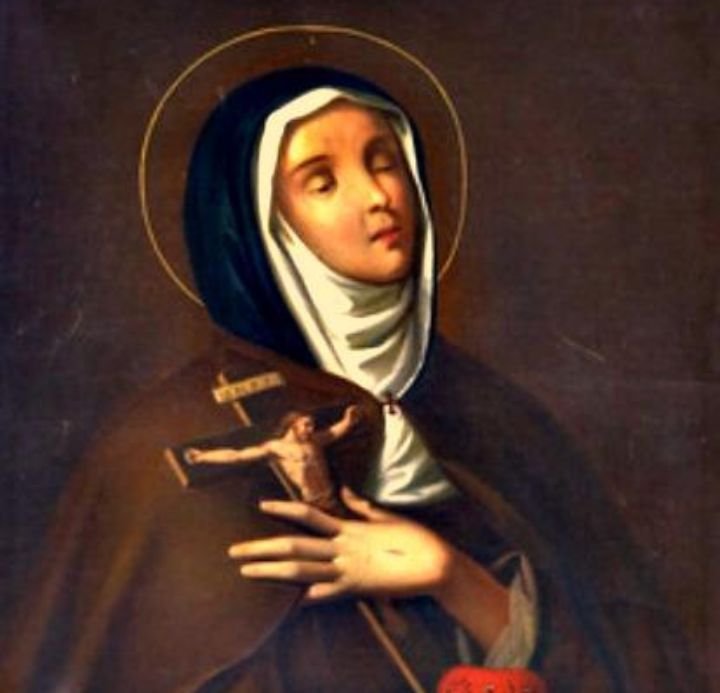
In the history of medieval Christianity, few stories are as unusual as that of Saint Clare of Montefalco, an Italian Augustinian nun and mystic whose heart was removed from her body after death and became the center of one of the most remarkable religious traditions of the Middle Ages.
According to historical and ecclesiastical accounts, when Clare died in 1308, her fellow religious sisters opened her body. They were reportedly astonished by what they believed they discovered inside her heart: shapes resembling the instruments of Christ’s Passion, including a cross and a scourge.
The extraordinary discovery became closely associated with Clare’s reputation for mystical devotion and eventually contributed to the development of her cult.
Who Was Clare of Montefalco?
Clare, also known as Saint Clare of the Cross, was born in Montefalco, Italy, around 1268. From childhood, she was deeply devoted to prayer and Christian asceticism.
She eventually joined the religious community established by her older sister, Giovanna. The community later adopted the Rule of Saint Augustine, and Clare became its superior after her sister’s death.
According to the Vatican’s account of her life, Clare became known not only for her intense religious devotion but also for offering counsel to priests, scholars and ordinary people who sought her guidance. She was particularly devoted to the Passion of Christ, the suffering and crucifixion of Jesus.
This devotion became especially important to the strange story surrounding her death.
“I Have Jesus Christ Crucified Within My Heart”
Clare reportedly spoke repeatedly about carrying Christ’s cross within her heart.
According to the Vatican, during a mystical experience in 1294, she believed Christ appeared to her carrying a large cross and told her that her heart was a place where the cross could be planted.
From then on, Clare frequently expressed the belief that Christ crucified was present within her heart.
Those statements took on a remarkable meaning after her death.
Clare died on August 17, 1308, at approximately 40 years of age. The day after her death, her fellow nuns opened her body. The Vatican’s historical account states that they examined her heart because of her repeated statements about having Christ crucified within it.
What they claimed to discover became the foundation of one of the most famous stories about her.
The Heart That Was Said to Contain a Cross
According to the tradition, the sisters discovered formations within Clare’s heart that resembled objects associated with the Passion of Christ.
Descriptions attributed to her early biographer Berengario de Sant’Africano included a cross, three nails, a sponge and reed, as well as a column, scourge and crown.
The Vatican’s Dicastery for the Causes of Saints records the tradition, saying that after Clare’s organs were removed, signs of Christ’s Passion were reportedly discovered in her heart. Her body and relics are still preserved at Montefalco.
Other accounts describe three small round stones found in the gallbladder. These were interpreted symbolically as representing the Holy Trinity.
The discovery quickly attracted attention beyond the convent.
Not Everyone Immediately Believed It
The story was extraordinary enough to provoke skepticism.
Historical accounts indicate that church authorities investigated the reported phenomena rather than simply accepting the story without examination. Berengario, who served as a representative of the Bishop of Spoleto, became one of Clare’s important early supporters after seeing the alleged signs.
The story also spread rapidly through Montefalco and surrounding areas.
The Italian Encyclopedia Treccani records that within days of Clare’s death, civic and ecclesiastical authorities went to the monastery to examine the reported phenomenon. Berengario subsequently collected testimony concerning Clare and became an important advocate for her reputation for holiness.
However, there is an important distinction between what historical sources record people believed they saw and what modern science can establish.
The alleged images in Clare’s heart should therefore be presented as a religious tradition and historical claim, not as a scientifically demonstrated supernatural event.
Indeed, the municipality of Montefalco itself describes the story as a tradition and notes that it arose from religious devotion and medieval understandings of anatomy.
Why Would Her Body Have Been Opened?
To a modern reader, the removal and examination of a person’s heart after death may seem shocking.
But medieval and early modern Christian societies had distinctive attitudes toward the bodies of holy people.
Relics, the physical remains or belongings associated with saints, could become important objects of devotion. Bodies might be preserved, examined or divided, particularly when religious communities believed that they contained signs of holiness.
Separately, the practice of removing hearts from prominent medieval individuals was not entirely unique. Historians have documented heart burial among European elites, sometimes allowing the heart and body to be buried in different places. Archaeological research has identified evidence of post-mortem heart removal in medieval Europe.
Clare’s case, however, was different because the heart itself became associated with alleged supernatural signs.
Her Heart Became a Relic
Clare’s reported heart was preserved as a relic, while her body also became an object of veneration.
The Vatican’s Dicastery for the Causes of Saints states that her incorrupt body and relics remain at Montefalco.
The monastery and local religious tradition continue to preserve the memory of the heart and the alleged signs discovered within it.
For believers, the story was not merely about a strange physical phenomenon. It was interpreted as an extraordinary confirmation of something Clare had repeatedly said during her lifetime: that Christ’s Passion was deeply imprinted within her.
The symbolism was therefore powerful.
She had spoken of Christ crucified in her heart, and after her death, her followers believed they had discovered physical signs corresponding to those words.
From Medieval Mystic to Saint
Clare’s reputation for holiness grew rapidly after her death.
Investigations into her life and reported miracles began relatively early, but her formal recognition took centuries. Her cause experienced interruptions before eventually being revived.
According to Vatican and ecclesiastical sources, her cult was confirmed in the 18th century, and Pope Leo XIII canonized Clare of Montefalco on December 8, 1881. Her feast is celebrated on August 17.
Today, she is remembered as an Augustinian mystic and is commonly depicted with symbols associated with the Passion of Christ.
Miracle, Symbol or Medieval Mystery?
More than seven centuries later, the story of Clare’s heart remains difficult to separate from the religious worldview of medieval Europe.
There is no modern scientific evidence establishing that an actual crucifix, crown of thorns or scourge physically developed inside her heart. What can be established historically is that medieval witnesses reported seeing formations that they interpreted as symbols of Christ’s Passion, that the reports were investigated, and that the story became deeply connected with Clare’s cult.
For the faithful, the heart became a powerful symbol of Clare’s spiritual life.
For historians, it offers an intriguing glimpse into medieval attitudes toward death, relics, mysticism and the human body.
And for anyone fascinated by the darker and stranger chapters of history, the story remains unforgettable:
A medieval nun repeatedly said that Christ’s cross was inside her heart. After her death, her sisters opened her body, and claimed to find the signs of that Passion within it.
That is the extraordinary story of Saint Clare of Montefalco, the medieval saint whose heart became one of the most unusual relics associated with Christian history.
The Historabase Editorial Team is dedicated to exploring and sharing the stories that have shaped Africa and the wider world. Our work covers African history, ancient civilizations, empires, historical figures, wars, cultures, political movements, and important events from the past.
We aim to present history in a clear, engaging, and accessible way, combining historical records with careful research to help readers better understand the people, events, and civilizations that shaped our world.