The Nigerian Civil War, fought between 1967 and 1970, remains one of the most consequential conflicts in Nigeria’s history. Often referred to as the Biafran War, the conflict emerged from political instability, ethnic tensions, military coups, violence, and disagreements over the future of the Nigerian federation.
For nearly three years, Nigerian federal forces fought the secessionist state of Biafra, which had declared independence from Nigeria under the leadership of Lieutenant Colonel Chukwuemeka Odumegwu Ojukwu. The war devastated communities, displaced millions of people, and created a humanitarian crisis whose effects remain part of Nigeria’s historical memory.
Nigeria Before the War
When Nigeria gained independence from Britain in 1960, it was a highly diverse country made up of numerous ethnic groups, languages, religions, and political interests. The country was broadly dominated by three large population groups, the Hausa-Fulani in the north, the Yoruba in the west, and the Igbo in the east, alongside hundreds of other ethnic communities.
Nigeria’s political system was organized around powerful regional governments. Competition between political parties and regions increasingly created tensions within the young federation.
The situation became significantly worse after the January 1966 military coup, which overthrew the civilian government. Although the coup involved officers from different ethnic backgrounds, many prominent northern political leaders were killed. This contributed to widespread suspicion that the coup was designed to give the Igbo greater political control.
In July 1966, northern military officers carried out a counter-coup. General Aguiyi-Ironsi, Nigeria’s military head of state, was killed, and Lieutenant Colonel Yakubu Gowon emerged as the country’s new leader.
The political crisis was accompanied by widespread violence against Igbo civilians living in parts of northern Nigeria.
Thousands of people were killed, while hundreds of thousands of Igbo and other easterners fled toward the Eastern Region.
The mass movement of people deepened the sense of insecurity and mistrust between Nigeria’s regions.
The Aburi Accord
In January 1967, Nigerian military leaders met in Aburi, Ghana, in an attempt to find a peaceful solution.
The meeting produced what became known as the Aburi Accord. The agreement proposed a looser federation in which the regions would have considerably greater autonomy.
However, disagreements emerged over how the agreement should be interpreted and implemented.
The failure to resolve these differences peacefully pushed Nigeria closer to war.
Biafra Declares Independence
On 30 May 1967, Lieutenant Colonel Chukwuemeka Odumegwu Ojukwu declared the independence of the Eastern Region as the Republic of Biafra.
The declaration was driven by fears over the safety of easterners, political disagreements with the federal government, and demands for greater regional autonomy.
The federal government under Yakubu Gowon rejected the declaration.
Nigeria was now facing the possibility of the country’s permanent breakup.
The War Begins
Federal military forces launched operations to prevent Biafra from separating from Nigeria.
The early stages of the war were particularly complicated because Biafran forces initially captured territory outside the Eastern Region.
However, federal forces eventually regained much of this territory and began advancing into Biafra.
The conflict quickly developed into a conventional war involving infantry, artillery, aircraft, armored vehicles, and naval operations.
The Struggle for Port Harcourt
Port Harcourt became one of the most strategically important locations in the war.
The city had a major port and was connected to Nigeria’s oil-producing region. Control of Port Harcourt therefore had enormous economic and military significance.
Federal forces captured the city in 1968, weakening Biafra’s access to the coast and limiting its ability to receive supplies.
The loss of Port Harcourt was a major setback for Biafran forces.
The Blockade and Humanitarian Crisis
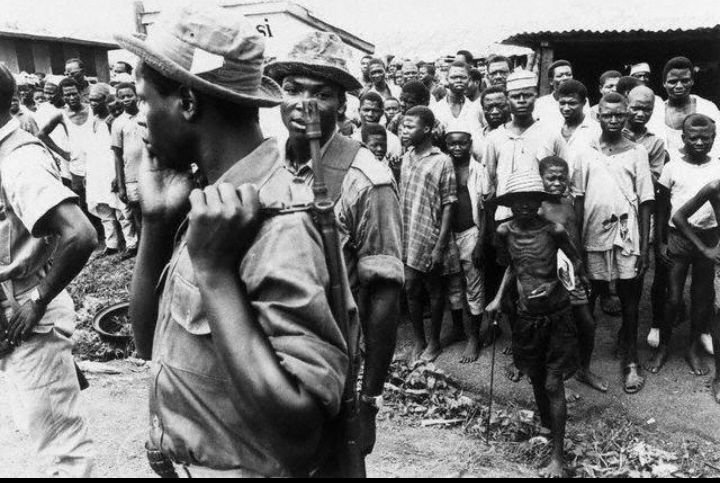
One of the darkest aspects of the Nigerian Civil War was the humanitarian disaster that developed in Biafra.
As federal forces established a blockade around Biafran territory, the movement of food, medicine, and other essential supplies became increasingly difficult.
Images of starving children became internationally known and generated significant humanitarian concern.
Relief organizations, churches, charities, and international groups attempted to deliver food and medical supplies to civilians.
The humanitarian crisis became one of the defining features of the conflict and attracted international attention.
Foreign Involvement
Although the war was fundamentally a Nigerian conflict, foreign governments became involved in different ways.
Britain generally supported the federal government, while France provided varying levels of political and material assistance to Biafra. Other countries and organizations also became involved through diplomatic, humanitarian, or military channels.
The conflict occurred during the Cold War, meaning international powers were also concerned about Nigeria’s strategic importance and regional stability.
However, Nigeria’s territorial integrity remained the central issue for the federal government.
The Role of Ojukwu
Ojukwu became the most recognizable political and military figure associated with Biafra.
He presented Biafra’s struggle as a fight for survival and self-determination, particularly after the violence experienced by easterners in 1966.
His leadership helped maintain Biafran resistance for almost three years despite growing military and economic pressure.
As federal forces gradually gained the upper hand, however, Biafra’s military position became increasingly difficult.
The Rise of Gowon’s Federal Forces
Yakubu Gowon’s government reorganized the Nigerian military and gradually strengthened federal control over territory.
Federal forces eventually captured important towns and strategic positions across Biafra.
By late 1969, Biafra had been reduced to a much smaller area.
The federal government launched its final major offensive in January 1970.
The End of the War
By the beginning of January 1970, Biafran resistance was collapsing.
Ojukwu left Biafra and traveled to Côte d’Ivoire, where he went into exile. Major General Philip Effiong assumed leadership of the remaining Biafran government.
On 15 January 1970, Biafran representatives formally surrendered to the federal government.
The Nigerian Civil War was over.
Gowon famously declared that there was “no victor, no vanquished,” emphasizing reconciliation rather than widespread punishment of the defeated side.
The Human Cost
The exact number of people who died during the Nigerian Civil War remains disputed. Estimates vary considerably, but the conflict resulted in an enormous loss of life.
Civilians suffered particularly heavily from hunger, disease, displacement, and military operations.
Millions of people were displaced from their homes during the conflict.
Entire communities were destroyed, infrastructure was damaged, and families were separated.
The psychological impact of the war also lasted long after the fighting stopped.
Nigeria After the War
The federal government attempted to reunify the country through a policy of reconciliation and reconstruction.
The government introduced the 3Rs: Reconstruction, Rehabilitation, and Reconciliation.
Despite this policy, the war left complicated political, economic, and social consequences.
Questions surrounding the treatment of former Biafrans, the distribution of political power, regional development, and the memory of the conflict continued to influence Nigerian politics.
Why the Nigerian Civil War Still Matters
The Nigerian Civil War was more than a military confrontation between the federal government and Biafra. It was the result of a series of political crises that exposed deep weaknesses within Nigeria’s newly independent political system.
The war demonstrated the dangers of military intervention in politics, ethnic mistrust, political exclusion, and unresolved regional grievances.
It also shaped Nigeria’s subsequent approach to national unity.
Today, the conflict remains a deeply significant subject in Nigerian history. For some, it represents a struggle for survival and self-determination. For others, it represents a critical moment when Nigeria’s territorial unity was preserved.
Both perspectives are important when studying the war.
Conclusion
The Nigerian Civil War tore Nigeria apart between 1967 and 1970, leaving behind a legacy of death, displacement, hunger, political transformation, and national trauma.
The conflict began after years of political and ethnic tension and ended with the defeat of Biafra and the preservation of Nigeria as a single country.
More than five decades later, the war remains one of the most debated periods in Nigerian history. Understanding it requires looking beyond the battlefield to the political crises, human suffering, and competing visions of Nigeria that brought the country to war.
The Historabase Editorial Team is dedicated to exploring and sharing the stories that have shaped Africa and the wider world. Our work covers African history, ancient civilizations, empires, historical figures, wars, cultures, political movements, and important events from the past.
We aim to present history in a clear, engaging, and accessible way, combining historical records with careful research to help readers better understand the people, events, and civilizations that shaped our world.







7 Comments